The Mystical Experience: First-Person Evidence for the Nonlocality of Consciousness
The mystical experience constitutes some of the most consistent first-person evidence for the nonlocality of consciousness available to researchers. Across cultures, centuries, and independently induced states—spontaneous awakening, Holotropic Breathwork, psychedelic therapy, meditative absorption—the structural report is identical: a dissolution of individual selfhood into an infinite, boundless field of awareness experienced as more real than ordinary waking consciousness. If the brain produced consciousness, such universally consistent experiences of infinite, nonlocal awareness would be structurally impossible.

Consciousness researcher and author of The Grand Illusion and Reverse Engineering the Afterlife.
The Highest Stage of Human Development Has Nothing to Do With the Intellect
Is the human's linear, reductionistic intellect the highest possible advancement of consciousness available to us? Bertrand Russell's research determined that mystics uniformly agree there is a better way to perceive than through the mind operating in ordinary five-sense mode. Ken Wilber, writing in The Atman Project, identified the problem precisely: "The individual ego is a marvelously high-order unity, but compared with the Unity of the cosmos at large, it is a pitiful slice of holistic reality. Has nature labored these billions of years just to bring forth this egoic mouse?"¹
Wilber observed that the rare individuals to have taken this problem seriously advanced the idea that the great mystics and sages "represent some of the very highest, if not the highest, of all stages of human development."¹ John Violette has referred to mystics as "evolutionary prodigies" whose messages were so badly misunderstood that the religions they spawned ended up leading people away from the intended message. Violette views the mystical experience as essential to the survival of the human race—history's most important natural phenomenon.²
The empirical data supports this. Sociologist Andrew Greeley at the University of Arizona tested people reporting profound mystical experiences using the Affect Balance Scale of psychological wellbeing—a standardised instrument for measuring healthy personality. The results were unambiguous. People who had mystical experiences achieved top scores. Norman Bradburn, the University of Chicago psychologist who developed the scale, stated that no other factor had ever been found to correlate so highly with psychological balance as mystical experience.³ Prior belief in the paranormal, religious involvement, and similar variables were not, on average, significant factors. The experiences occurred to "regular" people—and transformed them.
A First-Person Account of Nonlocal Consciousness
Sometime around the age of twenty, I experienced this mystical oneness directly. I was lying on my back in bed, waiting to go to sleep, having the usual difficulty quieting the mental chatter. I was completely lucid—not particularly tired—when a momentary cessation of that chatter occurred. Without any intent or expectation, I suddenly and inexplicably found that I was an infinite field of consciousness.
Not a gradual shift. One second I was lying awake; the next, my brainwave state having slowed and my breath having decreased subconsciously, I was experiencing myself as the universe in its entirety. I could feel planets and galaxies in the field of consciousness that I was. I was simultaneously everywhere and nowhere. I touched the farthest reaches of infinity and went on forever more. I didn't have a beginning or an end. I just was—completely beyond three-dimensional space-time and yet encompassing all of it.
I knew—as opposed to believed—that everything truly is interconnected in ways that the ordinary human senses cannot directly perceive. Essentially and literally, all is One. This is no metaphor but an observation gleaned from firsthand conscious experience. Gnosis. As William Blake said: "If the doors of perception were cleansed every thing would appear to man as it is, infinite. For man has closed himself up till he sees all things through narrow chinks of his cavern."
The only honest way to convey this experience is through analogy. This infinite awareness was not unlike what it might be like to be a hydrogen bomb exploding—with two major differences. First, there is no end to the explosion and no starting point. The reaches of exploding consciousness encounter no boundaries, only more of itself. Second, there is no real expanding outwards because there is nowhere to go that you are not already. Swami Rama Tirtha expressed his own realisation: "It is all One. There is neither me nor He. Everything is lost in One…Time and space have disappeared. There is no distance, inner or outer."
I was not dreaming, imagining, or thinking any of this. In a state of consciousness like that, thinking is likely to snap you out of it—it is a left-brain function binding you to space-time. During the mystical experience, the analytical, rationalizing intellect subsides entirely. You are, as the Zen teachers say, out of your ordinary mind.
I was completely awake and lucid before, during, and after. An awareness entered my consciousness that translated as "I am the universe and the universe is me." As soon as the analytical part of my mind tried to process this by thinking about it, the experience ended—almost as suddenly as it had begun. When I returned from that realm of formlessness to the ordinary world of multiplicity, I had, for the first time, encountered an experiential reality that showed me the difference between Reality and illusion, and between believing and knowing.
This was not the only mystical experience I have had, but the first and most impactful. I have since had physically tangible experiences of this infinite oneness sustained over longer controlled periods—feeling distant galaxies flowing through the body, not as metaphor but as a direct sensory event. Bell's theorem is right. Everything is fundamentally entangled.
Stanislav Grof's Research Demolished the Standard Model of the Psyche
What I experienced personally converges with what fifty years of systematic research into non-ordinary consciousness states has documented. Stanislav Grof—psychiatrist, founder of transpersonal psychology, former chief of psychiatric research at the Maryland Psychiatric Research Center—began his career as a committed materialist and atheist. His research changed that position irrevocably.
By the time he wrote The Holotropic Mind (1993), three decades of research into consciousness had convinced him of the "painful inadequacy" of established scientific models. He described these models collectively as a "conceptual straitjacket" preventing deeper understanding. His own database at that point included over 20,000 Holotropic Breathwork sessions with participants from different countries and all walks of life, plus 4,000 psychedelic sessions conducted in earlier phases of research.⁴
The conclusion Grof reached: "Modern consciousness research reveals that our psyches have no real and absolute boundaries; on the contrary, we are part of an infinite field of consciousness that encompasses all there is."⁴ This is not a metaphysical speculation. It is a conclusion derived from tens of thousands of documented sessions in which individuals—regardless of cultural background, religious affiliation, or prior belief—consistently accessed states of awareness that dissolved the boundaries of individual selfhood and revealed an underlying unity.
Grof found his research forcing him to acknowledge the existence of a transpersonal realm reaching far beyond the ordinary limits of mind—connecting individual psyches with what Jung called the collective unconscious and with the universe at large. Jung's own research decades earlier had already forced him beyond Freudian psychology for the same reason. What Grof recognised was that he was not discovering new territory but rediscovering ancient knowledge, "embodied in various esoteric and exoteric traditions, and wrongly rejected by an immature and conceptually crippled Western science."⁴
The Structural Report Is Identical Across Independent Traditions
The cross-tradition consistency of the mystical experience is not incidental. It is the primary evidential signal. Where independent observers across cultures, centuries, and belief systems arrive at structurally identical descriptions, the probability that they are describing the same underlying reality increases to the point where dismissal becomes intellectually untenable.
The Hindu Vedas—potentially dating back 7,000 years—describe Brahman: a unified field of pure consciousness sustaining, bathing, and permeating all of creation. The individual soul-spark within this infinite reality is Atman. Tibetan Buddhism calls the formless infinite mind Rigpa—"a primordial, pure, pristine awareness that is at once intelligent, cognizant, radiant, and always awake."⁵ Chinese sages called it the Tao. Islamic mysticism names it al haqq—the Truth, the Reality. Hebrew mysticism refers to the unmanifest ground as Ain Soph—the unconditioned fundamental ground of existence. Judeo-Christians call it God. The Zohar states: "Everything shall return to its Jesod, or foundation, from which it has proceeded. All marrow, seed and energy are gathered in this place."⁶
These are not parallel metaphors for the same vague feeling. They are independent structural descriptions of the same reported phenomenon: a field of infinite, boundless, self-aware consciousness that underlies and encompasses all manifest reality, accessible directly through altered or transcendent states.
The 15th-century Islamic saint Dadu wrote: "Ask of those who have attained God; all speak the same word…All the enlightened have left one message…it is only those in the midst of their journey who hold diverse opinions."⁷ Swami Abhayananda stated: "Their experience is my experience; for all who have realized the Truth have known that same eternal Self."⁸ The consistency is not cultural borrowing but structural convergence—the same phenomenon encountered through different routes by different observers.
What the Neuroscience Actually Tells Us
The standard materialist account holds that mystical experiences are neurological aberrations—unusual firing patterns in the brain mistaken for encounters with reality. The neuroscience does not support this conclusion.
One of the founders of modern brain research, neurosurgeon Wilder Penfield, believed toward the end of his life that consciousness is something more than neurochemistry alone could account for: "The mind has energy…different from that of neuronal potentials that travel the axon pathways."⁹ Psychologist and consciousness researcher Gary Schwartz has stated that "all of the findings in contemporary neuroscience are actually consistent with the hypothesis that the brain serves as an 'antenna-receiver' for consciousness rather than being the 'creator' of consciousness."¹⁰
The brain-as-receiver model explains what the brain-as-generator model cannot: why mystical consciousness states consistently produce an expansion rather than a reduction of awareness, why they yield information not available to the ordinary senses, and why the experience is universally described as more real than ordinary waking consciousness—not as hallucination, but as penetration to a deeper layer of reality that the ordinary senses habitually obscure.
Rick Strassman, whose DMT research at the University of New Mexico produced some of the most consistent nonlocal consciousness reports in the scientific literature, described the structural experience: "There no longer is any separation between the self and what is not the self. Personal identity and all of existence become one and the same…Past, present, and future merge together into the now of eternity…Space becomes vast. Like time, space is no longer here or there but everywhere, limitless, without edges."¹¹
This is not the report of a malfunctioning brain. It is the structural report of a consciousness that has, temporarily, been released from the filtering constraints of its biological substrate.
Physics Corroborates What the Mystics Reported
The convergence extends into physics. In 1967, John Wheeler and Bryce DeWitt published a reputedly successful attempt to merge quantum and classical descriptions of the universe. To solve the equation, time had to be eliminated—it simply disappears.¹² Physicist Carlo Rovelli has suggested that "the best way to think about quantum reality is to give up the notion of time—that the fundamental description of the universe must be timeless."¹³ Einstein stated: "Time is not at all what it seems. It does not flow in only one direction, and the future exists simultaneously with the past."
The mystic's report that "all is now"—that serial time is a sensory delusion and that all actuality, history, and potential exists simultaneously in the present—is not poetry. It is a description that the leading edge of theoretical physics is approaching from an entirely different direction. Two independent investigative methods describing the same structural feature of reality is evidence, not coincidence.
Biologist Mae Wan Ho states that each of us has the waves of all other organisms entangled within us.¹⁴ Physicist Michio Kaku writes that "what happens to us automatically affects things instantaneously in distant corners of the universe…In some sense there is a web of entanglement that connects distant corners of the universe, including us."¹⁵ The mystic's experience of being simultaneously a point of individuality and an infinite nonlocal field—"the micro and the macro, the Alpha and the Omega"—maps directly onto what quantum nonlocality describes at the physical level.
The Aftermath: What Mystical Experience Does to the Experiencer
The evidential weight of the mystical experience is not only in its content but in its transformative aftermath. Evelyn Underhill observed that "the true mystical experience never leaves the human subject at the level at which it found him."¹⁶ The changes documented are structural and lasting:
Thirst for knowledge increases dramatically, frequently drawing people toward physics, philosophy, and consciousness research. Empathy and compassion deepen. Fear of death dissolves. Materialistic thinking evaporates. Concern about status and self-image diminishes. Psychic sensitivity frequently increases—sometimes dramatically. Some individuals become notable for causing electrical equipment failures in their vicinity through proximity alone. Others find previously absent healing capacities emerging.
These patterns are not unique to spontaneous mystical states. They mirror the documented aftermath of near-death experiences, as Kenneth Ring established across his research career. Ring's study The Omega Project found the same pattern in close encounter experiencers.¹⁷ The common thread across all three groups—mystical experiencers, NDErs, and close encounter experiencers—is the temporary dissolution of biological filtering that allowed a deeper layer of consciousness to come through. The aftermath is the same because the underlying event is structurally the same.
One NDEr who had been a committed scientific materialist described what he encountered during clinical death: "I began receiving 'all knowledge'…this didn't come to me as words, but more as complete thoughts, complete words and pictures in my mind. As I could form a question in my mind I had the answer. Not just the answer to that question, but the why and how and the answer to every other question the answer would bring up. EVERYTHING in the entire universe fit together like a jigsaw puzzle. EVERYTHING MADE SENSE."¹⁷ Afterward, he obtained a second Ph.D. in the psychology of religion and became a minister—his view of spirituality universalistic and expansive rather than sectarian.
What the Mystical Experience Proves About the Nature of Consciousness
The implications are structural, not merely spiritual. If the brain produced consciousness, then the dissolution of ordinary brain function—the silencing of the analytical, rationalizing left-brain function that characterises the mystical state—should produce a reduction or impairment of awareness. It does not. It produces an expansion. The ordinary consciousness is revealed as the restricted state, and the mystical state as the baseline.
This is precisely the foundational premise of the Consciousness Transition Model: consciousness is not produced by the brain but filtered by it. The brain constrains what is available to ordinary waking awareness. When that constraint is temporarily lifted—through meditation, breathwork, psychedelic states, spontaneous awakening, or the approach of physical death—what emerges is not hallucination but a deeper structural layer of consciousness that the ordinary senses have been excluding.
The mystical experience is, in CTM terms, a temporary form of Perceptual Decoupling: a loosening of the biological filter sufficient to allow awareness of the nonlocal Consciousness Operating Environment that underlies physical reality. The Biological Disengagement Event at death is, on this model, the permanent version of the same loosening. What mystics encounter temporarily—the dissolution of ego-boundaries, the timeless present, the infinite field of awareness—is what the CTM maps as the baseline state of consciousness when biological constraint is permanently removed.
Grof's LSD research produced identical structural descriptions: "The insights emerging are of a global, intuitive and holographic nature…a transcendence of phenomena, space, time and causality. The experient does not gain rational understanding of the cosmic process, but reaches instant comprehension by losing his or her separate identity and literally becoming the process."¹⁸
The mystic cannot prove this to anyone outside the experience. But the fact that the structural report has remained essentially unchanged across 7,000 years of independently arrived-at accounts, across every culture and tradition that has seriously investigated consciousness, is not nothing. As logician Ludwig Wittgenstein conceded in his final work On Certainty: "The solution to the riddle of life in space and time lies outside space and time."¹⁹ The mystic has always said so.
"All the enlightened have left one message…it is only those in the midst of their journey who hold diverse opinions."—Dadu, 15th-century Islamic saint
Frequently Asked Questions
What is the mystical experience and what does it reveal about consciousness?
The mystical experience is a state of consciousness in which the ordinary sense of individual selfhood dissolves into a boundless, infinite field of awareness. The structural report is consistent across cultures, centuries, and independently induced states: a dissolution of ego-boundaries, the cessation of serial time, the experience of being simultaneously everywhere and nowhere, and an overwhelming sense that all is fundamentally One. Its primary implication for consciousness research is that the ordinary waking state is a restriction, not the baseline—and that consciousness is far larger than the brain that normally filters it.
Is there scientific evidence for nonlocal consciousness from mystical experience research?
Yes. Stanislav Grof's systematic research across 20,000 Holotropic Breathwork sessions and 4,000 psychedelic therapy sessions documented consistent reports of consciousness transcending the ordinary boundaries of the individual body, brain, and space-time. Andrew Greeley's sociological research found that mystical experience correlated more highly with psychological wellbeing than any other factor ever tested on the Affect Balance Scale. Neurosurgeon Wilder Penfield and consciousness researcher Gary Schwartz have both concluded that the neuroscientific evidence is more consistent with the brain functioning as an antenna-receiver for consciousness than as its generator.
Why do mystics across different cultures describe the same experience?
The cross-tradition consistency of the mystical state is the primary evidential signal. Hindu Vedanta describes Brahman—an infinite field of pure consciousness. Tibetan Buddhism describes Rigpa. Chinese Taoism describes the Tao. Islamic mysticism describes al haqq. Hebrew mysticism describes Ain Soph. None of these traditions had meaningful contact with each other, yet their structural descriptions of the mystical encounter are functionally identical. Independent observers arriving at the same structural description through different investigative routes constitutes convergent evidence for a real underlying phenomenon.
How does the mystical experience relate to near-death experiences?
The structural parallels are consistent and well documented. Both states involve the dissolution of ordinary ego-boundaries, a sense of infinite presence and timelessness, access to information not available through ordinary senses, and an overwhelming sense of unity and love. The transformative aftermath is also structurally identical across both groups: fear of death dissolves, empathy increases, materialistic thinking diminishes, and psychic sensitivity frequently increases. The Consciousness Transition Model maps both states as expressions of the same underlying phenomenon—biological filtering loosened (in the mystical experience) or permanently dissolved (in the near-death event).
What does the mystical experience tell us about time and space?
Consistently across mystical consciousness states, serial time is experienced as an illusion—all actuality, history, and potential appearing to exist simultaneously in the present. This is not an impression unique to mystical experients. Physicist John Wheeler stated, "There is no before, there is no after." The Wheeler-DeWitt equation—an attempt to merge quantum and classical physics—requires the elimination of time to be solved. Physicist Carlo Rovelli has proposed that the fundamental description of the universe must be timeless. The mystic's structural report about time has been consistently arriving at the same conclusion as theoretical physics from an entirely different direction.
How does the Consciousness Transition Model explain mystical experience?
The Consciousness Transition Model treats the mystical experience as a temporary form of Perceptual Decoupling—a loosening of the biological filter sufficient to allow direct awareness of the nonlocal Consciousness Operating Environment that underlies physical reality. On this model, the ordinary waking state is the restricted state, and the mystical state is the baseline. The Biological Disengagement Event at death is the permanent version of the same loosening—which explains why near-death experiencers and mystics describe structurally identical states. The mystic returns from the infinite field. The dying do not.
References
Show 21 references
- Wilber, K. The Atman Project: A Transpersonal View of Human Development. Quest Books, 1980.
- Violette, J. Transcendental Realism. Blue Dolphin Publishing, 1999.
- Greeley, A. Ecstasy: A Way of Knowing. Prentice-Hall, 1974. See also: Bradburn, N. The Structure of Psychological Well-Being. Aldine, 1969.
- Grof, S. The Holotropic Mind. HarperSanFrancisco, 1993.
- Rinpoche, S. The Tibetan Book of Living and Dying. HarperCollins, 1992.
- Zohar. Cited in Murphy, B.D. The Grand Illusion: A Synthesis of Science and Spirituality—Book 1. Chapter 5.
- Dadu. Cited in Abhayananda, S. History of Mysticism. Atma Books, 1987.
- Abhayananda, S. History of Mysticism. Atma Books, 1987.
- Penfield, W. The Mystery of the Mind. Princeton University Press, 1975.
- Schwartz, G.E. Cited in Murphy, B.D. The Grand Illusion—Book 1. Chapter 5.
- Strassman, R. DMT: The Spirit Molecule. Park Street Press, 2001.
- Wheeler, J.A. & DeWitt, B.S. (1967). Quantum gravity and the Wheeler-DeWitt equation. Physical Review, 160(5), 1113–1148.
- Rovelli, C. The Order of Time. Riverhead Books, 2018.
- Ho, M.W. The Rainbow and the Worm: The Physics of Organisms. World Scientific, 1998.
- Kaku, M. Hyperspace. Oxford University Press, 1994.
- Underhill, E. Mysticism: A Study in the Nature and Development of Spiritual Consciousness. Methuen, 1911.
- Ring, K. The Omega Project. William Morrow, 1992.
- Grof, S. LSD Psychotherapy. Hunter House, 1980.
- Wittgenstein, L. On Certainty. Blackwell, 1969.
- Brown, C. Cosmic Voyage. Dutton, 1996.
- Jung, C.G. On Death and Immortality (collected works). Princeton University Press.
Explore Further
→ The Consciousness Transition Model — The first structured, cross-tradition map of how consciousness moves through post-mortem states.
→ What NDE Research Actually Shows — The parallel evidential record from near-death experience research.
→ Terminal Lucidity: What It Is and What It Actually Proves — The evidence that consciousness operates independently of the brain.
→ What Happens When We Sleep — The nightly out-of-body state and what it reveals about death.
→ The Grand Illusion — Book 1: Chapter 5 develops the full argument on mystical experience, nonlocality, and the failure of brain-as-generator models.
→ Reverse Engineering the Afterlife — Book 2: the full CTM account of post-mortem consciousness states.
Brendan D. Murphy
Reverse Engineering the Afterlife
The full CTM account—post-mortem mechanics, substrate independence, and the structural map of what comes next.
Pre-Order Now →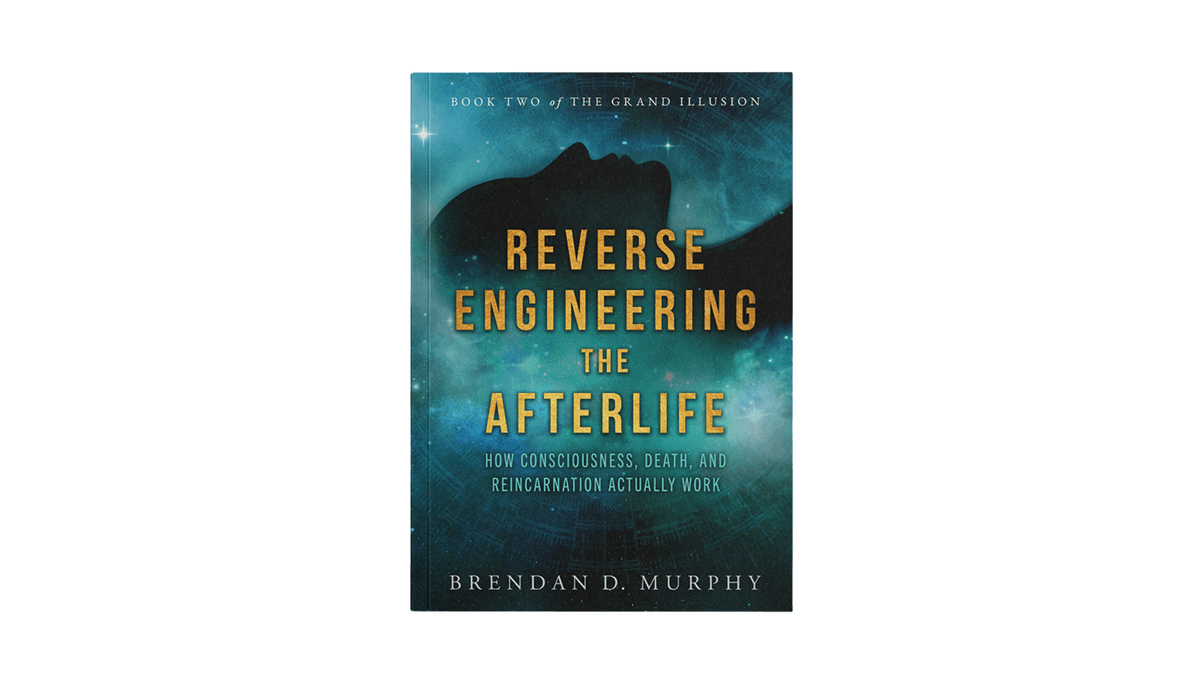
About the author
Brendan D. Murphy
Brendan D. Murphy is a consciousness researcher and author of The Grand Illusion and Reverse Engineering the Afterlife. Working at the intersection of consciousness science, comparative metaphysics, and systems thinking, he maps the architecture of consciousness and post-mortem states without the constraints of religion, materialism, or New Age ideology. He is the creator of the Consciousness Transition Model—the first structured, cross-tradition framework of how consciousness moves through post-mortem states. He publishes regularly on Substack and is based in México.
More about Brendan →