Terminal Lucidity: What It Is and What It Actually Proves
Terminal lucidity is the unexpected return of full cognitive awareness in patients with severe, long-standing neurological damage—Alzheimer's, brain tumours, meningitis—typically hours or days before death. It is documented in peer-reviewed literature spanning 250 years, named and systematised by biologist Michael Nahm and psychiatrist Bruce Greyson in 2009. Terminal lucidity represents one of the most direct challenges to materialist neuroscience: if consciousness is produced by the brain, its sudden coherent clarity in a severely damaged brain has no mechanistic explanation.

Consciousness researcher and author of The Grand Illusion and Reverse Engineering the Afterlife.
What Terminal Lucidity Is—and What It Is Not
The term was coined by Michael Nahm in 2009, defined as "the unexpected return of mental clarity and memory shortly before the death of patients suffering from severe psychiatric and neurologic disorders." The phenomenon itself is far older than the name. Hippocrates, Plutarch, Cicero, Galen, and Avicenna all documented cases in which mentally disturbed patients recovered lucidity as death approached. In the nineteenth century, it appeared regularly in medical literature under various names—"lightening up before death," "the dying rally," and in parts of Eastern Europe, "madness" or "possession by demons" in those cases where no other framework existed to account for it.
What terminal lucidity is not: it is not partial improvement in a deteriorating patient, not the plateau phase of a neurological condition, not misdiagnosis of the original impairment, and not confabulation. The defining feature is the conjunction of three conditions that should not coexist: severe, documented, long-standing neurological damage; the physical body actively dying; and the return—not gradual, often abrupt—of coherent, lucid, purposeful awareness. This conjunction is what makes terminal lucidity evidentially significant. Any one of these conditions alone is unremarkable. The three together represent a structural problem for the brain-as-producer model of consciousness.
Nahm and Greyson's 2009 literature survey, published in the Journal of Nervous and Mental Disease, identified 81 case references across the prior 250 years of medical literature, of which they were able to retrieve 49 detailed case reports. Their 2012 review in Archives of Gerontology and Geriatrics—co-authored with Emily Williams Kelly and Erlendur Haraldsson—extended this, documenting cases across brain abscesses, tumours, strokes, meningitis, dementia, Alzheimer's disease, schizophrenia, and affective disorders.
The Anna Katharina Ehmer Case
The most documented and striking case in the terminal lucidity literature is that of Anna Katharina Ehmer—the subject of a dedicated case study published by Nahm and Greyson in the Omega: Journal of Death and Dying in 2014.
Katharina Ehmer was a twenty-six-year-old German woman who had lived her entire life with severe mental and neurological disabilities. From birth she had experienced repeated bouts of meningitis, leaving her cortical tissue in a severely compromised state. She had never spoken a word in her life. She could not coordinate movement, could not engage meaningfully with her environment, and had no documented capacity for language of any kind. In modern neurological terms, there was no functional substrate for coherent cognition.
On March 1, 1922, she became lucid. Not vaguely alert—fully, completely lucid. And then, after a lifetime of complete mutism, she began to sing.
She sang a hymn—"Where Does the Soul Find Its Home, Its Peace?"—in full, structured form, for approximately thirty minutes. The attending physicians documented her face as appearing "transfigured and spiritualised." Shortly afterward, she died.
This case is published, peer-reviewed, and attributed to named witnesses. There is no neurological pathway that accounts for it. The biological substrate that had never in twenty-six years supported coherent expression produced it perfectly and continuously for half an hour—at the precise moment it was irrevocably failing. The brain-as-producer model does not merely struggle with this case. It has no answer for it.
A Second Category: The Return of Lifelong Absence
Physician and philosopher Gotthilf Heinrich Schubert documented two further cases that belong to the same structural category as Katharina Ehmer's.
In one, a man who had been deaf and mute his entire life—no speech, no auditory engagement, no linguistic expression across a full lifetime—began to speak comprehensively in his final hours. In a second case, an elderly man who had been entirely speechless for twenty-eight years recovered full awareness, speech, and coherent communication on the final day of his life. He had, apparently, experienced a vivid dream announcing the end of his suffering. Then he died.
These are not cases of neurological recovery. They are not cases of spontaneous remission of a reversible condition. They are cases in which capacities that had never existed, or had been absent for decades, appeared fully formed in the final hours of a life—at the precise moment the biological system producing them, according to materialist neuroscience, was catastrophically failing.
The Viral Video and What the Research Actually Shows
Many people searching for information on terminal lucidity have encountered an unverified terminal lucidity video circulating on social media—typically described as showing a terminal lucidity burn victim recovering apparent clarity before death. The video's authenticity and clinical context are unverified, and it has not been documented in any peer-reviewed medical literature.
What the peer-reviewed literature does document—across 250 years and dozens of rigorously recorded cases—is terminal lucidity in patients with severe neurological impairment: advanced Alzheimer's, brain tumours, meningitis, long-term schizophrenia, and conditions involving documented structural damage to the brain's cortical tissue. These are the cases that matter evidentially, precisely because the damage is verified, the prior incapacity is documented, and the return of lucidity has no mechanistic explanation within the brain-as-producer framework.
The burn victim video, whatever its provenance, does not advance the evidential case. The documented cases from Nahm and Greyson's research do. The distinction matters for anyone asking the serious question.
The Standard Explanations—and Why They Collapse
The sceptical literature has proposed several explanations for terminal lucidity. Each fails on examination—not because of a general bias toward dismissal, but because the explanations do not fit the specific evidential structure of the strongest cases.
Residual function. The argument that some undamaged neural tissue remained capable of supporting lucidity. This does not hold for cases involving global or lifelong impairment—Katharina Ehmer's cortex had been repeatedly damaged by meningitis across her entire life, and she had never demonstrated the capacities she expressed in her final thirty minutes. There is no "residual function" account of a capacity that had never previously functioned.
Neurochemical surges. The argument that dying releases neurochemicals capable of temporarily enhancing cognition. Neurochemistry does not rebuild identity, structured language, musical memory, and purposeful communication in patients who have never possessed these capacities. The proposed mechanism explains a temporary enhancement of existing function. It does not explain the appearance of capacities that were entirely absent.
Random fluctuation. The argument that random neural noise occasionally produces coherent output by chance. This fails statistically and structurally. Katharina Ehmer's hymn was not random output. It was thirty minutes of structured, coherent musical expression, with correct lyrics, melody, and articulation. The probability of random neural fluctuation producing this in a brain that had never supported language is not low. It is effectively zero.
Misdiagnosis. The argument that the original conditions were less severe than documented. This fails for cases with multiple independent clinical records—and Nahm and Greyson were specifically working with historical cases that had been documented by physicians, not retrospectively reported by family members.
What all of these explanations share is the same structural failure: they account for fragments of some terminal lucidity cases while being wholly inadequate for the strongest ones. Peter Fenwick's methodological point about the NDE literature applies equally here—you have to account for it as a package. The sceptical responses address the easy cases while ignoring the ones that actually carry evidential weight.
What Terminal Lucidity Actually Implies
The structural implication is not subtle. If the brain produces consciousness, and the brain is severely and documentably damaged, and has been so for years or a lifetime, then coherent, structured, purposeful consciousness should be impossible. Terminal lucidity shows that it is not. The only framework that accommodates this is one in which the brain mediates and constrains consciousness rather than generating it.
This is the brain-as-filter model, advanced by William James in 1898 and developed by Henri Bergson and Aldous Huxley: the brain does not produce consciousness but constrains and focuses it, selecting from a broader field of awareness what is relevant to physical survival. If this is correct, then severe brain damage disrupts expression, not existence. The consciousness that had always been present—constrained rather than absent—becomes briefly accessible again as the filtering system finally releases its hold.
Terminal lucidity, on this reading, is not an anomaly. It is expected. It is what the filter model predicts when the filter begins to fail.
This is precisely how the Consciousness Transition Model maps it. The final hours of life involve a progressive disengagement of consciousness from its physical operating context—what the CTM calls the Biological Disengagement Event. As that disengagement begins, the filtering and constraining function of the damaged brain relaxes. Consciousness, which has always been operating beyond the biological interface, becomes briefly more accessible. The person returns—not because the brain recovered, but because its constraining function is loosening.
What happens next—what consciousness encounters as it fully disengages from the physical—is the territory mapped in Reverse Engineering the Afterlife.
Why Terminal Lucidity Matters Beyond the Individual Cases
Terminal lucidity does not stand alone. It aligns with three other lines of empirical research that collectively constitute the strongest challenge to the brain-as-producer model: near-death experience research documenting veridical perception during verified clinical death; out-of-body experience research documenting accurate environmental perception from outside the physical body; and reincarnation research documenting past-life memory and birthmarks at locations corresponding to previous-life wounds. All four lines of evidence point toward the same structural conclusion: consciousness is not produced by the brain.
Terminal lucidity is, however, one of the cleanest examples—precisely because it occurs in conditions where the brain-as-producer account should be strongest. Severe, verified neurological damage. Physical death actively in progress. And yet: coherent, purposeful, structured consciousness. The model predicts this should be impossible. The evidence shows it is not.
That is not an anomaly to be explained away. It is a data point that demands a better model.
"Terminal lucidity occurs under the conditions where the brain-as-producer model should be most secure—severe neurological damage, active dying—and produces the outcome the model says is impossible. That is not an edge case. That is a refutation."
The Filter Is Failing. The Signal Is Getting Through.
Terminal lucidity is one of the most evidentially significant phenomena in consciousness research—not despite occurring under conditions of severe neurological damage, but precisely because of it. The brain-as-producer model predicts that consciousness degrades as the brain degrades. Terminal lucidity shows the opposite: as the brain fails, something appears that the functioning brain had suppressed.
The implication is structural. Consciousness is not produced by the brain. It is constrained by it. And in the final hours of life, as that constraint releases, what has always been present becomes briefly, fully, and sometimes remarkably visible.
What happens as that release completes—the full post-mortem transition—is mapped in the Consciousness Transition Model and detailed in Reverse Engineering the Afterlife.
Frequently Asked Questions
What is terminal lucidity?
Terminal lucidity is the unexpected return of full mental clarity and coherent awareness in patients with severe, long-standing neurological damage—typically hours or days before death. The term was coined by biologist Michael Nahm and psychiatrist Bruce Greyson in 2009. It has been documented in peer-reviewed medical literature for over 250 years, in patients with Alzheimer's disease, brain tumours, meningitis, schizophrenia, and other conditions involving documented structural brain damage.
What is terminal lucidity meaning in simple terms?
In simple terms: a person who has lost the ability to think, speak, or recognise their family—often for months or years—suddenly recovers full clarity shortly before dying. They recognise loved ones, speak coherently, express themselves, and then die. Terminal lucidity is notable because the medical condition that removed these capacities has not improved—it has, if anything, worsened. The brain is actively failing at the moment the mind appears most present.
Why does terminal lucidity happen?
No mainstream medical consensus exists on the mechanism of terminal lucidity. The standard explanations—residual neural function, neurochemical surges, random fluctuation—fail against the strongest documented cases, particularly those involving lifelong impairment or global neurological damage. The brain-as-filter model, developed from William James through Henri Bergson and supported by the broader consciousness research literature, proposes that as the brain's filtering and constraining function relaxes during the dying process, the consciousness it has been constraining becomes briefly accessible again.
Is terminal lucidity real?
Yes. Terminal lucidity is documented in peer-reviewed medical literature spanning 250 years, including systematic case collections published by Nahm and Greyson in the Journal of Nervous and Mental Disease (2009) and Archives of Gerontology and Geriatrics (2012). The cases include patients with brain abscesses, tumours, strokes, meningitis, dementia, Alzheimer's disease, and schizophrenia. It is not contested whether the phenomenon occurs—it is contested what mechanism produces it.
What causes terminal lucidity?
The cause of terminal lucidity is not established by mainstream neuroscience. Proposed mechanisms include neurochemical changes, disinhibition of surviving neural circuits, and metabolic shifts at end of life. None of these adequately account for the strongest documented cases—particularly those involving lifelong cognitive impairment or conditions in which the brain's cortical tissue has been severely and irreversibly compromised. The Consciousness Transition Model maps terminal lucidity as a consequence of the progressive disengagement of consciousness from its physical operating context: as the brain's constraining function relaxes, the consciousness operating beyond it becomes briefly accessible.
How long does terminal lucidity last?
Duration varies significantly across documented cases. In approximately half of documented cases, terminal lucidity occurs within the final twenty-four hours of life. In nearly ninety percent of cases, it occurs within the final week. The duration of the lucid episode itself ranges from minutes to several hours. Katharina Ehmer's case—thirty minutes of continuous, structured singing—is among the more extended documented episodes. The lucidity is typically followed by rapid physical decline and death.
What is the terminal lucidity burn victim video?
A video circulating on social media—typically described as showing a burn victim regaining clarity before death—has driven significant search interest in terminal lucidity. The video's authenticity, clinical context, and circumstances have not been verified by any peer-reviewed source. No burn victim terminal lucidity case appears in the academic literature on the phenomenon (Nahm 2009, 2012; Greyson et al.). The documented cases that carry evidential weight are those with verified neurological conditions, independent clinical witnesses, and published peer-review—not social media footage of unknown provenance.
Terminal lucidity debunked—is there a credible counter-argument?
No debunking of terminal lucidity has succeeded against the strongest documented cases. The proposed alternative explanations—residual neural function, neurochemical surges, random fluctuation, misdiagnosis—each fail for specific structural reasons when applied to cases like Katharina Ehmer's: a patient with lifelong, documented cognitive impairment who had never previously demonstrated the capacities she expressed in her final thirty minutes. A credible counter-argument would need to account for the full evidentiary package of the strongest cases. None of the proposed counter-arguments do this.
References
Show 6 references
- Nahm, M. & Greyson, B. (2009). Terminal lucidity in patients with chronic schizophrenia and dementia: A survey of the literature. Journal of Nervous and Mental Disease, 197(12), 942–944. https://pubmed.ncbi.nlm.nih.gov/20010032/
- Nahm, M., Greyson, B., Kelly, E.W. & Haraldsson, E. (2012). Terminal lucidity: A review and a case collection. Archives of Gerontology and Geriatrics, 55, 138–142. https://med.virginia.edu/perceptual-studies/wp-content/uploads/sites/360/2016/12/OTH25terminal-lucidity-AGG.pdf
- Nahm, M. & Greyson, B. (2013–2014). The death of Anna Katharina Ehmer: A case study in terminal lucidity. Omega: Journal of Death and Dying, 68(1). https://journals.sagepub.com/doi/10.2190/OM.68.1.e
- Mashour, G.A. et al. (2019). Paradoxical lucidity: A potential paradigm shift for the neurobiology and treatment of severe dementias. Alzheimer's & Dementia, 15(8), 1107–1114.
- Nahm, M. (2009). Terminal lucidity in people with mental illness and other mental disability: An overview and implications for possible explanatory models. Journal of Near-Death Studies, 28, 87–106.
- James, W. (1898). Human Immortality: Two Supposed Objections to the Doctrine. Ingersoll Lecture, Harvard University.
Explore Further
→ The Consciousness Transition Model — The first structured, cross-tradition map of how consciousness moves through post-mortem states.
→ Terminal Lucidity (Glossary) — The short definition, with the core evidence and how the CTM reads it.
→ The Hard Problem of Consciousness Is Not Going Away — Why neuroscience cannot explain mind—and what terminal lucidity adds to that argument.
→ What NDE Research Actually Shows — The parallel evidential challenge from near-death experience research.
→ Reverse Engineering the Afterlife — Book 2: the full CTM account of what happens as consciousness disengages from its physical context.
→ The Grand Illusion — Book 1: the foundational research into consciousness, the brain-filter model, and the failure of materialism.
Brendan D. Murphy
Reverse Engineering the Afterlife
The full CTM account—post-mortem mechanics, substrate independence, and the structural map of what comes next.
Pre-Order Now →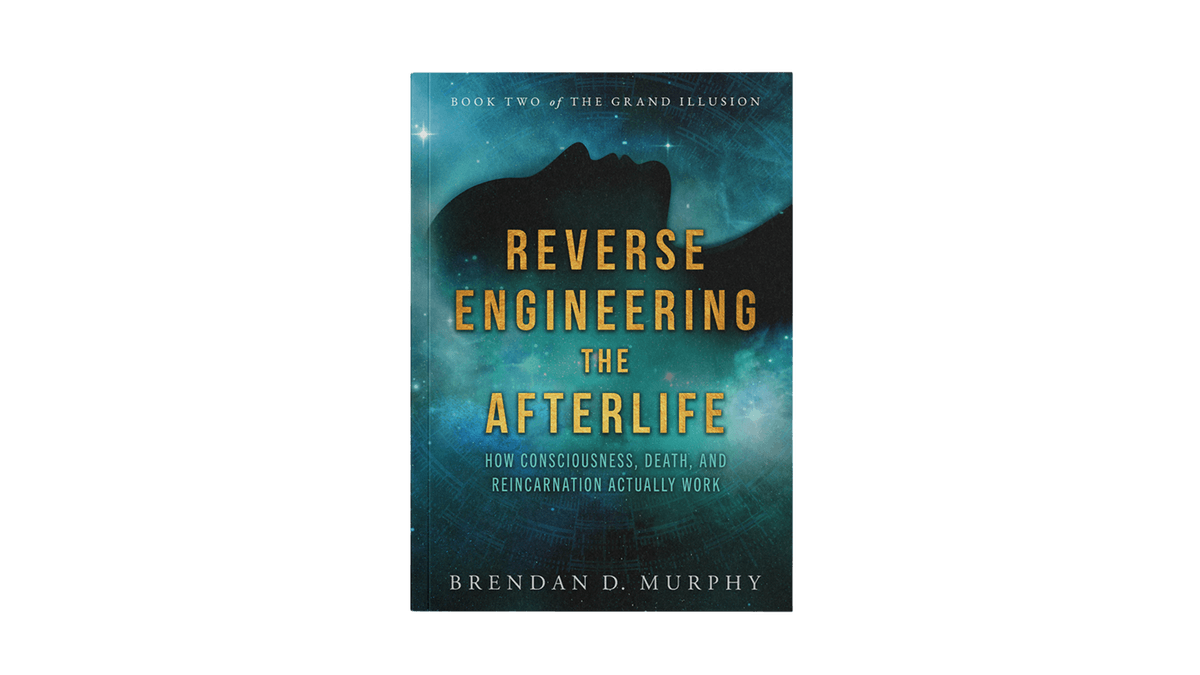
About the author
Brendan D. Murphy
Brendan D. Murphy is a consciousness researcher and author of The Grand Illusion and Reverse Engineering the Afterlife. Working at the intersection of consciousness science, comparative metaphysics, and systems thinking, he maps the architecture of consciousness and post-mortem states without the constraints of religion, materialism, or New Age ideology. He is the creator of the Consciousness Transition Model—the first structured, cross-tradition framework of how consciousness moves through post-mortem states. He publishes regularly on Substack and is based in México.
More about Brendan →