What Happens When We Sleep: The Nightly Out-of-Body State and What the Evidence Shows
The evidence for OBE during sleep converges across independent research streams: Monroe Institute's Hemi-Sync program tested over 3,000 subjects and concluded that all humans exit the physical body during sleep. Charles Tart's EEG-monitored laboratory studies documented out-of-body states during sleep in verified subjects. Cross-tradition accounts—Theosophical, Mesopotamian, indigenous—independently describe the same nightly out-of-body experience. Sleep, on this evidence, is not unconsciousness. It is a nightly excursion.

Consciousness researcher and author of The Grand Illusion and Reverse Engineering the Afterlife.
Robert Monroe's Research Arrived at a Conclusion Most Scientists Won't Touch
Robert Monroe (1915–1995), former radio executive and one of the most methodical investigators of out-of-body experience in the twentieth century, had his first OBE in 1958 at age forty-three. What began as an unsought personal anomaly became decades of systematic investigation through the Monroe Institute in Faber, Virginia. By 1985, Monroe's team had conducted Hemi-Sync process tests with over 3,000 subjects across a minimum of twenty individual trials per participant—more than 60,000 trials in total.¹
The conclusions Monroe and his team reached were not vague. They were specific, falsifiable, and highly consonant with what occult and esoteric traditions had been stating for centuries without the benefit of instrumentation.
Chief among those conclusions: all humans move out of phase with physical matter reality and into the out-of-body state during sleep. During deep or delta sleep, consciousness is completely detached from physical reality. Some form of non-physical energy or awareness enters the body prior to birth and leaves at death, taking its accumulated experience with it. Human consciousness is inherently non-physical. At death—as in the out-of-body state—people naturally move into an environment that resonates with the coherence state of their awareness. And survival of physical death is not a belief system but a natural consequence of what consciousness actually is.¹
Monroe was not a mystic making metaphysical claims. He was a researcher who spent decades subjecting these propositions to experimental testing and concluded that they held. As he put it, through the Hemi-Sync process people come to know—not believe—that they survive physical death, regardless of what they do or don't do in life.
This matters evidentially because Monroe arrived at essentially the same map as the esoteric traditions through an entirely different route.
Laboratory Evidence Supports the Nightly Exit
Monroe's institutional research is the largest body of sleep OBE research, but it is not the only one. Psychologist Charles Tart conducted controlled physiological studies of OBE during sleep at the University of California Davis in the 1960s. In his 1968 study published in the Journal of the American Society for Psychical Research, Tart monitored a subject—Miss Z—using EEG, EOG (eye movement), and other physiological measures during sleep while she attempted to identify a randomly generated five-digit number placed on a shelf above her head, accessible only if she were genuinely perceiving from an out-of-body vantage point. On the fourth night of testing, Miss Z correctly identified the number (25132). The probability of guessing correctly was 1 in 100,000. Her EEG during the OBE period showed an unusual pattern—non-REM theta waves with no rapid eye movements—distinct from normal dreaming and distinct from waking consciousness.²
This is not anecdote. It is a controlled laboratory study with physiological monitoring, a verifiable target, and a correct result that chance cannot reasonably account for. The out-of-body state during sleep left a measurable neurological signature and produced verifiable information from a vantage point physically inaccessible to the sleeping body.
Frederik van Eeden, a Dutch psychiatrist and member of the Society for Psychical Research, collected and analysed 352 lucid dream cases between 1898 and 1912, published in the SPR Proceedings in 1913. Van Eeden distinguished carefully between ordinary dreams, lucid dreams, and anomalous states—a category that overlaps substantially with OBE reports during sleep. His systematic case analysis constitutes one of the earliest rigorous attempts to categorise the phenomenology of altered sleep states, and it anticipated by decades the research Monroe would later conduct instrumentally.³
Every Major Tradition Arrived at the Same Conclusion Independently
The cross-tradition convergence on this point is not coincidental. It is evidential. Where independent observers across cultures, centuries, and belief systems arrive at the same structural description of what happens during sleep, the probability that they are describing the same underlying phenomenon increases significantly.
Mesopotamian literature contains the idea that the soul—or some part of it—moves out from the body of the sleeping person and actually visits the places and persons the dreamer sees in sleep.⁴ The Poso Alfures of Celebes (Indonesia) describe three souls: the vital principle (inosa), the intellectual element (angga), and the divine element (tananoa)—the latter of which leaves the body during sleep and wanders in dreams.⁵ Variations on the same trinary theme appear across multiple unconnected cultures. The shared structural concept—an intelligent, mobile principle that separates from the physical during sleep—is not a borrowed idea. It is an independently arrived-at description of the nightly out-of-body experience.
Manly P. Hall, writing in The Secret Teachings of All Ages, observed that the Eleusinian initiates of ancient Greece—whose mystery tradition ran from approximately 1600 BCE to 392 CE—almost certainly understood that the soul left the body during sleep, and that their training was specifically designed to make this departure conscious and controllable.⁶
Charles W. Leadbeater, writing in 1915, described what he and other trained observers had consistently found:
"There are many among us who are able to perform (and do perform every day of their lives) this elementary act of magic in full consciousness—who pass from one plane to the other at will; and if that is clearly realized, it will become apparent how grotesquely absurd to them must appear the ordinary unreasoning assertion that such a thing is utterly impossible. It is like telling a man that it is impossible for him to fall asleep, and that if he thinks he has ever done so he is under a hallucination."⁹
This is not mysticism. It is a description of a repeatable, cross-verified perceptual phenomenon—the nightly out-of-body experience—reported consistently by trained observers across traditions that had no contact with each other.
What Sylvan Muldoon Found About Sleep Depth and the Nightly Exit
Sylvan Muldoon, one of the most systematic early investigators of spontaneous OBE, wrote in the 1920s that the astral body—what the Consciousness Transition Model would frame as the awareness operating beyond the physical Consciousness Operating Environment—moves slightly out of coincidence with the physical body each night, absorbing what he called "cosmic force" or prana. The distance between the astral and the physical determined the depth of sleep and the degree of recuperation achieved.⁶
The farther the astral body moved from the physical, the more easily it could condense the ambient energetic charge. This is why physical exhaustion produces deeper sleep—the system requires a greater degree of energetic replenishment, and deeper separation achieves it. Muldoon also noted that conscious projection prevents the reenergising process. The nightly exit must be unconscious for ordinary sleep recovery to occur. For most people, this means the OBE during sleep is happening nightly, but without awareness.
As sleep deepens, the astral double moves progressively higher until it roams freely in what the traditions call the astral plane—what the CTM maps as an intermediate Consciousness Operating Environment distinct from physical reality—before cycling back into the physical body before waking. Out-of-body traveller and author Preston Dennett independently confirmed Monroe's conclusion that we all go out of phase with physical space-time each night. The event that initially confirmed this for him personally was waking one night to find himself standing out of bed in the dark, already out of his body, flooding with panic at the thought he had died—before diving immediately back in.⁸
The consistency across experiencers who had no shared theory is notable. Monroe arrived at this through instrumented laboratory research. Muldoon arrived at it through spontaneous experience and systematic self-observation. Dennett arrived at it accidentally. They describe the same event.
Karagulla's Documented Cases of Nocturnal Learning
In Breakthrough to Creativity (1967), physician and researcher Shafica Karagulla documented an extensive range of anomalous perceptual experiences in mainstream professionals—including a number of medical practitioners who described attending structured classes while asleep at night. These are documented accounts from Karagulla's single-source clinical interviews, not controlled experimental data. What makes them significant is their internal consistency and the detail of the corroboration between separate individuals.
Karagulla writes of these experiences:
"These are not usual dream experiences…None of the irrelevancies appear which are commonly associated with dreams. The lectures are as precise and clear as those given in a college classroom. The individual in question receives instruction and information which is accurate and often useful to him in his work."¹⁰
More significantly: friends and acquaintances were independently reporting attendance at the same classes, recalling the same lectures on the same subjects.¹⁰ Shared experience across separate percipients is one of the more compelling structural arguments for these sleep states being genuine perceptual events rather than private hallucinations. If two people who had not coordinated their accounts describe the same classroom, the same lecturer, and the same content—verified afterward by phone—this is precisely the kind of corroborating evidence that elevates anecdote toward documentation.
One of Karagulla's subjects—a physician she identifies as Dr. Philip, beloved by his patients and frequently consulted by the Mayo Clinic for his diagnostic precision—had kept secret that his extraordinary clinical insight was grounded in direct anomalous perception. He could observe the interior condition of a patient's body directly, detect pathology without external assistance, and pre-cognitively map the course of a condition. During sleep, he attended a medical college where lucid lectures were given; in the morning he could remember everything in detail. He had been trained there to see into the body. He instructed Karagulla to make the information public only after his death.¹¹
A second subject, Vicki, had spent her entire life visiting the same buildings during sleep—architecturally unlike anything in the physical world. In those classes, lecturers manifested three-dimensional thought-form models as teaching aids, rotating and altering them at will. Vicki was able to verify the presence of a friend at one session—he recalled attending the same class, though his memory of the content was less detailed.¹³
The thought-form models as instructional tools in these accounts are structurally identical to what NDE experiencers and between-lives regression clients describe in the interlife states—a convergence that the Consciousness Transition Model maps as a consistent feature of intermediate Consciousness Operating Environments. The environments are thought-responsive. Instruction occurs. Identity persists.
Monroe's Terminology and the Occult Map Are the Same Map
By 1985, Monroe had synthesised the findings of his sleep OBE research into a descriptive framework that departed from traditional occult language but described the same underlying structure. Monroe's "rings" correspond to the septenary plane arrangement described by Theosophists and other occult traditions. What occultists call a "spirit," Monroe called a "curl." What occultists call a "thought-form," Monroe called a "rote-ball." What Theosophists call "telepathy," Monroe called "rote transfer."¹⁵
Don DeGracia, a biochemist and out-of-body traveller, observed that Monroe's "rings" correspond closely to the septenary arrangement of planes described by occultists, and yet from Monroe's perspective these are merely the "backwoods" of a far vaster interdimensional civilisation.¹⁶
What this terminological convergence demonstrates is not that Monroe was secretly an occultist. It demonstrates that independent investigators working from entirely different methodological traditions—one instrumental and experimental, one initiatory and observational—arrived at structurally identical descriptions of the same territory. This is exactly the kind of cross-tradition convergence that the Consciousness Transition Model was built to identify and map. The traditions disagree on symbolic language. They agree on structure. The structure is what the CTM tracks.
Sylvan Muldoon also noted the phenomenon now commonly called sleep paralysis and referred to it as "astral catalepsy"—asserting that the condition indicated the astral double was also cataleptic at that moment, temporarily unable to complete re-entry into the physical body.¹⁷ This framing positions what millions of people experience as an alarming neurological event as a consequence of incomplete physical re-synchronisation after a genuine out-of-body state during sleep. The experience is common, global, and poorly explained by the dominant neurological model.
Every Night Is a Rehearsal for What Happens at Death
The implication that emerges from all of this sleep consciousness research is not subtle. If every human being exits the physical body during sleep—if delta-state consciousness is operating in a non-physical Consciousness Operating Environment every night of our lives—then death is not the unprecedented departure it is feared to be.
The difference between sleep and clinical death is structural, not categorical. In sleep, the physical body and its etheric correlate remain living and functional, maintaining the energetic connection that allows re-entry. Death is the permanent disengagement of consciousness from the physical-etheric system after that system has become non-functional—what the CTM calls the Biological Disengagement Event. The exit itself is the same event. The difference is whether the door remains open for return.
In this sense, we "die" every night—we exit the physical body, operate in non-physical environments, and return in the morning. The terror of death, where it exists, is partly a terror of something we have in fact been doing our entire lives without awareness. Monroe's conclusion was that this is not a matter of belief. It is a natural fact of what consciousness is. His 60,000-plus trials of experimental testing led him there. The cross-tradition record confirms it. The laboratory evidence of OBE during sleep from Tart and van Eeden corroborates it at the physiological level.
The full architecture of what awaits when the door does not reopen—the post-mortem transition mapped across NDE research, esoteric traditions, and systems thinking—is the subject of the Consciousness Transition Model and developed in detail in Reverse Engineering the Afterlife.
"If all humans exit the physical body during sleep and operate in non-physical environments each night, then death is not an unprecedented event. It is the permanent version of something consciousness has been doing all along."
Sleep Is Not Unconsciousness. It Is Departure.
Five independent streams—Monroe Institute's instrumented research, Tart's EEG-monitored laboratory studies, van Eeden's 352-case phenomenological analysis, Muldoon's systematic self-observation, and the convergent cross-cultural record—all point to the same structural conclusion: during sleep, consciousness operates outside the physical body in a non-physical environment.
The mainstream model of sleep as neural downtime cannot account for Tart's verified five-digit result, Monroe's 60,000-trial dataset, or the consistent cross-tradition descriptions of the same exit mechanics arrived at independently. That is not how anomalies are supposed to accumulate when a model is correct.
If the nightly exit is real—and the evidence establishes that it is—then death is the permanent version of an event we have been rehearsing every night of our lives. The full post-mortem map is in the Consciousness Transition Model and in Reverse Engineering the Afterlife.
Frequently Asked Questions
What happens to consciousness during sleep?
The convergent evidence from Monroe Institute sleep OBE research, Theosophical documentation, and cross-cultural tradition indicates that consciousness—specifically the non-physical awareness that operates through the body—partially or fully exits the physical during sleep. During deep or delta sleep, this separation is most complete. The physical body remains functional and connected by what researchers and traditions describe as a cord or energetic link; the awareness operates in a non-physical state. Monroe's 3,000-subject Hemi-Sync research program in the 1980s concluded this is universal, not rare.
Is there scientific evidence for OBE during sleep?
Yes. Psychologist Charles Tart conducted controlled EEG and physiological monitoring of out-of-body states during sleep at UC Davis. In his 1968 study, a subject correctly identified a five-digit number (25132) placed on a shelf accessible only from an out-of-body vantage point—a 1-in-100,000 probability result—while displaying a distinctive non-REM theta EEG signature inconsistent with ordinary dreaming. The Monroe Institute's Hemi-Sync program tested over 3,000 subjects across more than 60,000 trials and consistently documented the nightly out-of-body experience.
What is astral projection during sleep?
Astral projection during sleep is the spontaneous exit of the non-physical aspect of consciousness—the astral body, in traditional terminology—from the physical body during the sleep state. In CTM terminology, this represents a form of perceptual decoupling from the physical Consciousness Operating Environment, with awareness shifting to a non-physical operational context. According to Monroe Institute research and cross-tradition documentation, this occurs to some degree in all humans during sleep, though awareness of the event is rare without specific training.
Why do we have out-of-body experiences during sleep?
According to Sylvan Muldoon's model—supported structurally by Monroe Institute findings—the nightly out-of-body experience serves an energetic function: the non-physical awareness moves away from the physical body to absorb what Muldoon called cosmic force or prana, with the distance of separation determining the depth of sleep and degree of recuperation. The more depleted the physical system, the farther the separation and the deeper the sleep. On this account, the OBE during sleep is not incidental but functional—it is how consciousness recharges the physical system it operates through.
How is sleep related to death according to consciousness research?
The structural relationship between sleep and death is one of the more consistent findings across independent sleep consciousness research traditions. Monroe Institute research concluded that delta-state sleep involves complete detachment of consciousness from physical reality—the same separation that becomes permanent at death. The CTM maps death as the Biological Disengagement Event: the permanent exit of consciousness from its physical Consciousness Operating Environment once that environment becomes non-functional. In sleep, re-entry is possible because the physical-etheric system remains alive. At death, it is not, and the etheric double separates from the physical permanently, along with the other subtle bodies and mind-fields. The exit is a similar event—one reversible, the other not.
What is sleep paralysis in relation to OBE?
Sylvan Muldoon described sleep paralysis as "astral catalepsy"—a condition in which the astral double is also temporarily immobile, unable to complete re-entry into the physical body. The conventional neurological account attributes sleep paralysis to a mismatch in the timing of REM atonia and waking consciousness. Muldoon's account frames it as a physical symptom of incomplete re-synchronisation between the returning non-physical awareness and the physical body after a nightly out-of-body experience. The two accounts are not necessarily incompatible—one describes the neurological correlate; the other describes the experiential and structural mechanism.
References
Show 19 references
- Monroe, R.A. Far Journeys. Doubleday, 1985. 63–4, 31.
- Tart, C.T. (1968). A psychophysiological study of out-of-the-body experiences in a selected subject. Journal of the American Society for Psychical Research, 62(1), 3–27.
- van Eeden, F. (1913). A study of dreams. Proceedings of the Society for Psychical Research, 26, 431–461.
- Mishlove, J. The Roots of Consciousness. Random House, 1975.
- Christie-Murray, D. Reincarnation: Ancient Beliefs and Modern Evidence. Prism Press, 1981. 23.
- Muldoon, S. & Carrington, H. The Projection of the Astral Body. Rider & Co., 1929. 148–9.
- Powell, A.E. The Mental Body. Theosophical Publishing House, 1927. Chapter 18.
- Dennett, P. Out-of-Body Exploring: A Beginner's Approach. Hampton Roads, 2004. 9.
- Leadbeater, C.W. Invisible Helpers. Theosophical Publishing Society, 1915. Chapter 5.
- Karagulla, S. Breakthrough to Creativity. DeVorss & Company, 1967. 246.
- Ibid. 72–73.
- Ibid. 111–112.
- Ibid. 113.
- Monroe, R.A. Far Journeys. 31.
- DeGracia, D.J. Beyond the Physical. 104.
- Ibid. 103.
- Muldoon, S. & Carrington, H. The Projection of the Astral Body. Note on astral catalepsy.
- Powell, A.E. The Astral Body. Theosophical Publishing House, 1926. Chapter 9.
- Hall, M.P. The Secret Teachings of All Ages. Philosophical Research Society, 1928.
Explore Further
→ The Consciousness Transition Model — The first structured, cross-tradition map of how consciousness moves through post-mortem states.
→ What NDE Research Actually Shows — The parallel evidential record from near-death experience research.
→ Terminal Lucidity: What It Is and What It Actually Proves — The evidence that consciousness operates independently of the brain.
→ The Grand Illusion — Book 1: the foundational research into consciousness, the non-physical body, and the failure of materialism.
→ Reverse Engineering the Afterlife — Book 2: the full CTM account of what happens as consciousness disengages from its physical context.
Brendan D. Murphy
Reverse Engineering the Afterlife
The full CTM account—post-mortem mechanics, substrate independence, and the structural map of what comes next.
Pre-Order Now →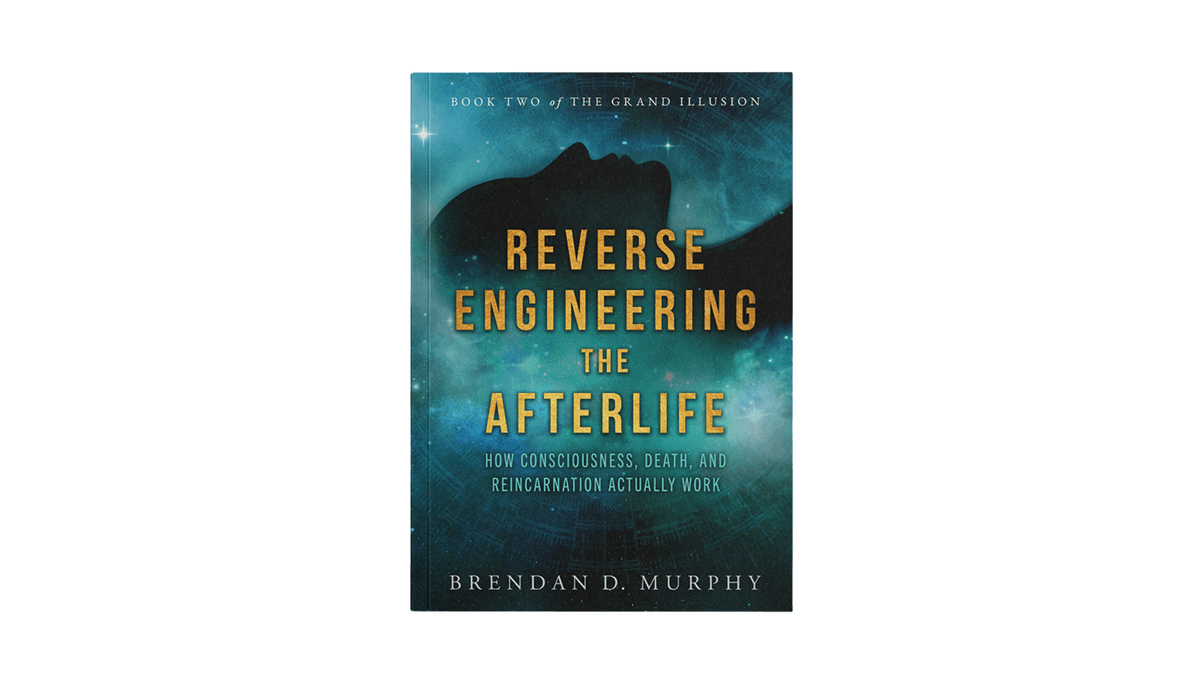
About the author
Brendan D. Murphy
Brendan D. Murphy is a consciousness researcher and author of The Grand Illusion and Reverse Engineering the Afterlife. Working at the intersection of consciousness science, comparative metaphysics, and systems thinking, he maps the architecture of consciousness and post-mortem states without the constraints of religion, materialism, or New Age ideology. He is the creator of the Consciousness Transition Model—the first structured, cross-tradition framework of how consciousness moves through post-mortem states. He publishes regularly on Substack and is based in México.
More about Brendan →