What NDE Research Actually Shows
Near-death experience research has been dismissed for decades. The dismissal is not based on the evidence. Here is what forty years of data actually shows—and why the mainstream interpretation fails.

Consciousness researcher and author of The Grand Illusion and Reverse Engineering the Afterlife.
Near-death experience research has been dismissed, marginalised, and misrepresented for decades. The dismissal is not based on the evidence. It is based on a prior commitment to a framework the evidence does not support. Forty years of data—prospective hospital studies, cross-cultural comparisons, longitudinal follow-up research—consistently produce findings that the materialist model cannot explain. The most significant of these is veridical perception: the accurate acquisition of specific, verifiable information during verified periods of clinical death.
The Dataset: What We Are Actually Working With
The serious NDE literature begins with Raymond Moody's Life After Life (1975) and extends through four decades of increasingly rigorous research. From 1975 to 2005 alone, forty-two studies covering more than 2,500 NDE patients were published in peer-reviewed journals and research monographs. Despite differences in study design and selection criteria, they produced highly consistent findings.
The researchers who have contributed most significantly include Kenneth Ring, Michael Sabom, Bruce Greyson, Pim van Lommel, P.M.H. Atwater, Jeffrey Long, Penny Sartori, Janice Miner Holden, Sam Parnia, Peter Fenwick, Melvin Morse, Cherie Sutherland, and Allan Kellehear, among others. This is not a fringe literature. It involves prospective hospital studies, cross-cultural comparisons, and longitudinal follow-up research conducted by credentialled scientists, physicians, and psychiatrists.
The features that appear consistently across NDE accounts—across cultures, time periods, and individuals with no prior exposure to NDE literature—include a clear sense of leaving the body and observing it from outside; movement through darkness or a tunnel; encounter with light described as conscious, benevolent, and of overwhelming intensity; meeting deceased relatives or other figures; a life review that is panoramic, non-linear, and profoundly evaluative; a boundary or threshold beyond which return is impossible; and return to the body accompanied by lasting psychological change. The consistency across independent accounts is not noise. It is signal.
The Veridical Problem: What Materialist Accounts Cannot Explain
The most important challenge to the materialist interpretation of NDEs is veridical perception—also called veridical NDE—the accurate acquisition of specific, verifiable information during periods of documented unconsciousness or clinical death.
Pim van Lommel's 2001 Lancet study remains the most methodologically rigorous prospective investigation of NDEs conducted to date. The study involved 344 consecutive cardiac arrest patients across ten Dutch hospitals. In a subset of cases, patients reported accurate, specific perceptions of events in the resuscitation room during verified periods of flat EEG—not vague impressions, but the location of objects, conversations between staff, the number of people present, and specific procedural details. These perceptions occurred during periods when the patients had no measurable brain activity. If experience requires brain activity, these cases cannot exist. They do exist.
Sam Parnia's AWARE studies employed a similar prospective design, placing hidden visual targets on high shelves viewable only from above—the most direct empirical approach to the veridical question yet designed.
Peak in Darien cases—in which experiencers encounter deceased individuals whose death they had no prior knowledge of—constitute a further evidentially significant category. In one documented case, a twelve-year-old girl told NDE researcher Elisabeth Kübler-Ross about being lovingly held by her brother during her experience. Her father was astonished—her brother had died before she was born, and her parents had never told her.
Among the most evidentially compelling cases on record is that of George Rodonaia, a Russian physician killed by KGB agents in 1976. Pronounced dead on arrival, his body was stored in a hospital freezer for three days. During this period, Rodonaia later reported a sustained out-of-body experience in which he perceived that a neighbour's newborn infant had a broken hip, the result of being dropped by a nurse. When Rodonaia revived on the autopsy table, he warned of the injury. X-rays confirmed a fresh fracture. The nurse subsequently admitted to dropping the baby. This case involves verifiable medical information obtained during three days of clinical death. It has no adequate materialist explanation.
The Mainstream Response: Why It Fails
The standard materialist responses—dying brain activity, oxygen deprivation, neurochemical cascades, temporal lobe stimulation, or memory confabulation—have been examined and found insufficient by researchers within the field itself.
Neuropsychiatrist Peter Fenwick has been direct: the reductive explanations account for fragments of some NDE accounts. They do not account for the package—particularly the veridical perception cases, which require that accurate information be obtained by a mechanism other than normal sensory function. Elizabeth Fenwick made the methodological point precisely: you have to account for it as a package and sceptics simply do not do that.
Recent neuroscience complicates the dying-brain narrative further. Research at the University of Montreal identified novel quasi-rhythmic wave activity originating in the hippocampus during coma states deeper than those reflected by isoelectric EEG. Research at the University of Michigan found transient synchronous bursts of highly coherent gamma wave activity in rats within thirty seconds of cardiac arrest—activity that exceeded waking levels. As Dirk Meijer notes, reducing brain activity—not increasing it—facilitates the most complex and coherent NDE experiences. This is the inverse of what the brain-as-producer model predicts. It is precisely what the brain-as-filter model predicts.
A 2014 study by Arianna Palmieri and colleagues at the University of Padova examined NDE memories using EEG and found they are structurally different from memories of imagined events—stored as episodic memories of real experiences, not confabulation or imagined narratives.
Cross-Cultural Consistency and What It Implies
The consistent structural features of NDEs across cultures present a further problem for neurological accounts. If NDEs were simply the product of dying brain chemistry, we would expect them to vary significantly across cultural contexts. What we find instead is a structural consistency—the same sequence, the same features, the same evaluative life review—across individuals separated by culture, century, and prior belief.
Cultural variation does exist, and it is instructive: the content of encounters, the imagery of environments, the identity of figures encountered are all shaped by cultural expectation and individual psychology. But the underlying structure is consistent. This is exactly what the filter model would predict: a consistent non-physical domain rendered differently through the lens of individual consciousness. The Tibetan Buddhist who encounters wrathful deities and the American Protestant who encounters Jesus are navigating the same structural environment through different symbolic lenses.
What NDE Research Does Not Show
Intellectual honesty requires acknowledging what the data does not establish. NDEs do not prove a specific afterlife cosmology—they suggest that consciousness persists beyond physical death and continues to operate in a structured domain, but do not establish the doctrinal claims of any particular religious tradition. NDEs do not prove that all post-mortem experience is uniformly pleasant—a significant minority, estimated at 15–20% in the literature, involve distressing or frightening elements. NDEs do not prove that death is without consequence—they suggest continuation, but the nature, duration, and conditions of that continuation are not established by the NDE literature alone. And the veridical cases establish consciousness without active brain function; they do not establish permanent survival. The distinction matters. These qualifications are not weaknesses in the evidence. They are the marks of an honest engagement with it.
Toward a Structural Framework
The NDE dataset, taken seriously, points toward a model in which consciousness is not produced by the brain but transmitted through it—and in which a structured non-physical domain exists that consciousness can access, particularly when the filtering function of the brain is reduced or temporarily removed. The brain-as-filter model was advanced by William James and Henri Bergson, developed by Aldous Huxley, and is the conclusion that emerges from taking the NDE data seriously on its own terms.
The Consciousness Transition Model was built from this foundation—not as a cosmology or belief system, but as a structural framework that attempts to map what the cross-tradition dataset, including NDE research, regression data, and comparative esoteric traditions, consistently points toward.
"The mainstream response to NDE evidence has not been to engage with it on its own terms. It has been to apply reductive explanations that account for fragments while ignoring the whole—a strategy that the evidence, taken seriously, does not support."
Conclusion
Near-death experience research is one of the most systematically studied anomalous phenomena in modern science. The dataset is large, consistent, and includes a category of veridical NDE perception cases that cannot be explained by any mechanism available to the materialist framework. What do near-death experiences prove? Not a specific cosmology—but that consciousness operates beyond the brain. The mainstream response has not been to engage with it on its own terms—it has been to apply reductive explanations that may account for fragments while ignoring the whole.
What the research points toward is a model in which consciousness is not generated by the brain but operates through it—and persists beyond it. This is where serious inquiry into consciousness after death begins.
Frequently Asked Questions
What does NDE research actually prove? Do NDEs prove afterlife?
NDE research does not prove survival of consciousness in the philosophical sense. What it does is falsify the strong form of the materialist hypothesis—the claim that consciousness is produced by, and entirely dependent on, brain activity. Veridical perception NDE cases cannot be accounted for by any mechanism the materialist framework currently offers. The question of whether NDEs prove afterlife is distinct: the evidence points toward consciousness surviving physical death, but does not establish any tradition's specific cosmology.
What are the most evidentially significant NDE cases? What do NDE research findings show?
The most evidentially significant NDE research findings fall into two categories: veridical NDE cases, in which experiencers accurately report specific details during verified clinical death; and Peak in Darien cases, in which experiencers encounter deceased individuals whose death (or existence!) they had no prior knowledge of.
Why do NDEs look different across cultures? What does near death experience science say?
Near death experience science shows that cultural variation in NDE content is systematic. The underlying structure—departure, transition, encounter, life review, boundary, return—is consistent. This is exactly what a brain-as-filter model would predict: a consistent non-physical domain rendered differently through the lens of individual consciousness.
What is the dying brain hypothesis and why does it fail?
The dying brain hypothesis holds that NDEs are produced by unusual brain activity during the dying process. Neuropsychiatrist Peter Fenwick has stated directly that none of these explanations account for the full NDE experience, particularly near-death experience veridical perception cases. Research shows that reducing brain activity—not increasing it—is associated with the most complex NDE experiences. This is the inverse of what the dying brain model predicts.
Are NDE memories real memories?
Yes, according to a 2014 study by Arianna Palmieri and colleagues at the University of Padova. NDE memories showed patterns characteristic of real episodic memories—not confabulation or imagined narratives.
What does the Consciousness Transition Model say about NDE evidence consciousness?
The Consciousness Transition Model treats NDE evidence consciousness research as windows into early-phase post-mortem transition. The consistent structural features of NDEs across cultures reveal the architecture of the initial transition process: disengagement from physical consciousness, encounter with the non-physical domain, the Memory Integration Loop, and the boundary as the limit of reversible transition.
References
Show 10 references
- Van Lommel, P. et al. (2001). Near-death experience in survivors of cardiac arrest. The Lancet, 358, 2039–2045.
- Van Lommel, P. Consciousness Beyond Life (2010).
- Ring, K. Life at Death (1980); Heading Toward Omega (1984).
- Greyson, B. After (2021). University of Virginia Division of Perceptual Studies.
- Fenwick, P. & Fenwick, E. The Truth in the Light (1995).
- Long, J. Evidence of the Afterlife (2010).
- Atwater, P.M.H. Beyond the Light (1994); The Forever Angels (2019).
- Moody, R. Life After Life (1975).
- Parnia, S. Erasing Death (2013).
- Palmieri, A. et al. (2014). "Reality" of near-death experience memories. Frontiers in Human Neuroscience.
Explore Further
→ The Consciousness Transition Model
→ The Hard Problem of Consciousness Is Not Going Away
Brendan D. Murphy
Reverse Engineering the Afterlife
The full CTM account—post-mortem mechanics, substrate independence, and the structural map of what comes next.
Pre-Order Now →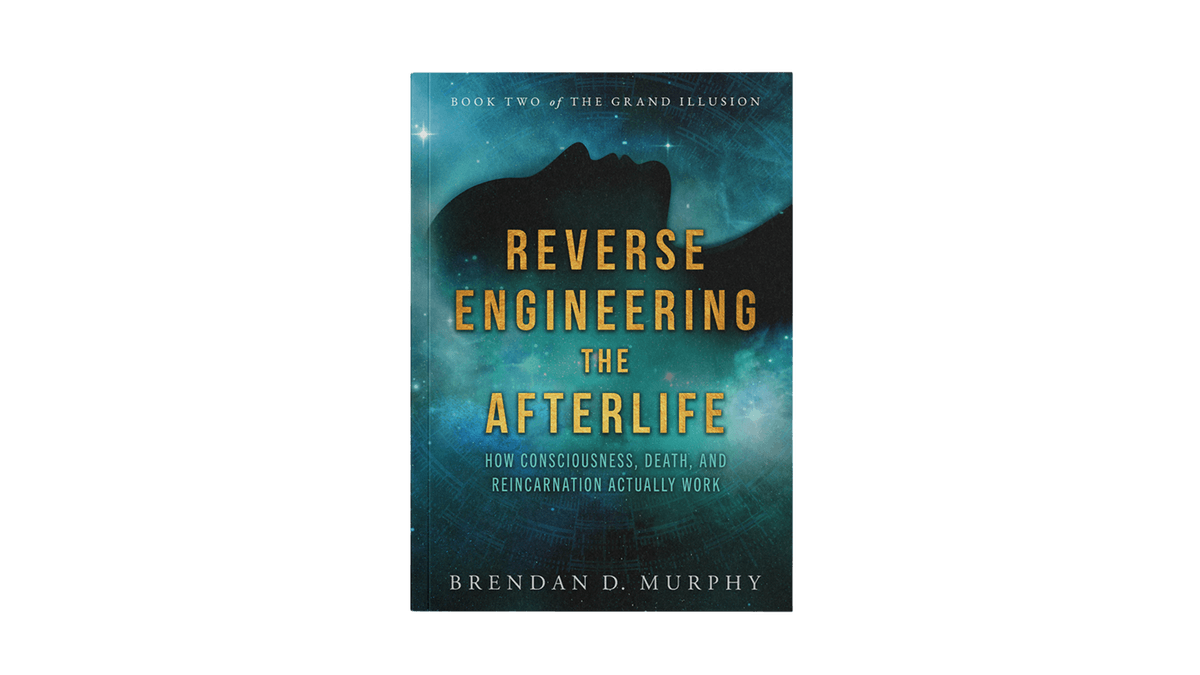
About the author
Brendan D. Murphy
Brendan D. Murphy is a consciousness researcher and author of The Grand Illusion and Reverse Engineering the Afterlife. Working at the intersection of consciousness science, comparative metaphysics, and systems thinking, he maps the architecture of consciousness and post-mortem states without the constraints of religion, materialism, or New Age ideology. He is the creator of the Consciousness Transition Model—the first structured, cross-tradition framework of how consciousness moves through post-mortem states. He publishes regularly on Substack and is based in México.
More about Brendan →