The Hard Problem of Consciousness Is Not Going Away
David Chalmers named it in 1995. Thirty years later it remains exactly where he left it: a structural gap no neuroscience has closed. What the hard problem actually means for every model of mind.

Consciousness researcher and author of The Grand Illusion and Reverse Engineering the Afterlife.
David Chalmers named it in 1995, and the philosophical establishment has been trying to dissolve it ever since. Thirty years later, it remains exactly where he left it: a structural gap between any third-person description of neural activity and the first-person fact of experience. The hard problem of consciousness asks why physical brain processes give rise to subjective experience at all—not how does the brain generate consciousness, but why that processing is accompanied by experience. The Consciousness Transition Model starts from the premise that this gap is not a puzzle to be dissolved, but a structural indicator that the materialist framework is pointing in the wrong direction.
The Problem, Precisely Stated
The "easy problems" of consciousness—how the brain integrates information, how it responds to stimuli, how it generates behaviour—are not actually easy. They are enormously complex. But they are tractable in principle. Given enough time and data, a mechanistic account could, in principle, explain them.
The hard problem of consciousness is different in kind. It asks why there is an inside to experience—why seeing red, feeling grief, hearing music feels like anything at all. Not how does the brain generate consciousness—not how it processes wavelengths of light, but why that processing is accompanied by experience at all. This is the question of qualia—the subjective, first-person character of experience—and it is a question that no amount of progress on the easy problems can touch.
A complete neuroscientific account of colour vision—every photoreceptor, every cortical map, every signal comparison process—leaves entirely open the question of why the processing of light at 700 nanometres is accompanied by the experience of redness. The neural correlate of redness is not redness. The map is not the territory, and the mechanism is not the experience. This gap is not a gap in our current knowledge. It is a gap in the type of explanation being offered.
Why the Standard Responses Fail
The standard moves in response to the hard problem do not close the gap.
Functionalism holds that mental states are defined by their functional roles—what they do, not what they are made of. The functionalist response to the hard problem is to assert that once all the functions are explained, consciousness comes along automatically. But this is not an explanation. It is an assertion. A zombie—a being that performs all the same functions as a conscious person while having no subjective experience—is conceivable under the functionalist framework. If zombies are conceivable, functionalism has not explained why we are not zombies. It has merely assumed the problem away.
Eliminativism holds that consciousness as ordinarily understood does not exist—that talk of qualia and subjective experience is folk psychology that will eventually be eliminated by mature neuroscience. This position cannot account for the evident reality that experience is occurring. Whatever else one might say about the hard problem, the existence of experience is the one thing that cannot be denied.
Illusionism—the position associated with Daniel Dennett and others—holds that qualia as we conceive them are illusions. But the illusion of experience is itself an experience, and explaining why we are under the illusion is just the hard problem relocated rather than resolved.
None of these positions close the explanatory gap. Chalmers, Nagel, Strawson, Jackson, and others who have taken the problem seriously on its own terms have all concluded that materialism as currently formulated cannot account for consciousness. The response from mainstream cognitive science has largely been to ignore them.
What the Hard Problem Implies for the Brain-Consciousness Relationship
If experience is genuinely irreducible to physical process—if no third-person account can capture first-person facts—then the standard framework does not simply need refinement. It needs replacement. The assumption that the brain produces consciousness and the brain activity are the same thing is precisely the assumption the hard problem challenges. If consciousness and the brain cannot be identified—if consciousness cannot be derived from or reduced to neural activity—then the brain is not the source of consciousness. It is, at most, the medium through which consciousness operates during physical life.
This is the position advanced by William James in his 1898 Ingersoll Lecture, developed by Henri Bergson in Matter and Memory, and elaborated by Aldous Huxley in The Perennial Philosophy. The brain-as-filter model holds that the brain does not generate consciousness but constrains and focuses it—selecting from a broader field of awareness what is relevant to physical survival.
The same logic applies to sleep. If consciousness exits the physical body every night during deep sleep—as Monroe Institute's 60,000-trial research program concluded, and as Charles Tart's EEG-monitored laboratory studies corroborated—then the brain-as-filter model has independent experimental support from an entirely different evidential direction. What the sleep OBE research actually shows →
Terminal lucidity is particularly instructive here. Cases in which individuals with severe neurological damage—advanced Alzheimer's, terminal brain tumours, decades-long vegetative states—recover full cognitive clarity in the hours or days before death cannot be explained by the brain-as-producer model. If consciousness is produced by the brain, and the brain is severely damaged, lucid consciousness should be impossible. It occurs. The brain-as-filter model accounts for it directly: as the brain begins to disengage from physical life, its filtering function relaxes, and the consciousness it has been constraining operates more freely.
The Hard Problem as a Pointer
The hard problem does not merely resist solution within the materialist framework. It tells us something precise about its limits: that the third-person methodology of physical science cannot, in principle, account for first-person facts. This is a structural feature of the type of explanation physical science offers.
If consciousness is not produced by the brain, then the question shifts from "how does the brain produce consciousness?" to "what is consciousness, and what does it interact with?" This is an empirical question—but it requires investigation that the materialist framework formally excludes. NDE research, psi data, past-life recall, survival evidence—all of which bear directly on the nature of mind—are excluded in advance by a framework that assumes its conclusion.
The Consciousness Transition Model begins where the hard problem points: with Primacy of Consciousness—consciousness as the fundamental substrate of reality, not an epiphenomenon of it—and Substrate Independence—the capacity of consciousness to operate outside the biological systems that constrain it during physical life. This framework supports nonlocal consciousness: the evidence that awareness is not confined to the brain or even to the body, and can operate independently of its physical substrate. These are not metaphysical claims added to the evidence. They are the framework the evidence points toward when the hard problem is taken seriously rather than dissolved.
"The hard problem is not a puzzle to be dissolved. It is a structural indicator that the materialist framework is pointing in the wrong direction. If consciousness cannot be produced by neural activity, the question is not how to explain it within that framework. The question is what it actually is."
Conclusion
The hard problem is thirty years old. It has not been solved because it cannot be solved within the framework that generated it. The productive direction is not deeper neuroscience aimed at the same problem with the same tools. It is a structural account of consciousness that begins from the right premise: that consciousness is not produced by the brain, that the brain is a mediating system rather than a generating one, and that the evidence for what consciousness actually is lies in the empirical territory that materialism has been systematically excluding.
That territory is what the Consciousness Transition Model maps.
Frequently Asked Questions
What is the hard problem of consciousness? Is the hard problem not solved?
The hard problem of consciousness, named by philosopher David Chalmers in 1995, asks why physical brain processes give rise to subjective experience at all. It is distinguished from the "easy problems" of consciousness because it cannot in principle be solved by any purely physical or functional explanation. The hard problem is not solved—thirty years later it remains structurally intact.
Has the hard problem of consciousness been solved? Why is the hard problem not solved?
No. The hard problem is not solved because it cannot be solved within the framework that generated it. Functionalism, eliminativism, and illusionism do not close the explanatory gap—they move it or assume it away. Chalmers, Nagel, and Strawson have all concluded that materialism as currently formulated cannot account for consciousness.
What is the difference between the hard problem and the easy problems of consciousness?
The easy problems concern the functional aspects of cognition—tractable in principle. The hard problem asks why functional processing is accompanied by subjective experience at all. No amount of progress on the easy problems touches the hard problem because they are different types of question.
Why does functionalism fail to solve the hard problem?
Functionalism holds that once all the functions are explained, consciousness comes along automatically. But this is not an explanation—it is an assertion. A complete functional account of colour perception leaves entirely open why any of that processing is accompanied by the experience of seeing red. This is why how does the brain generate consciousness remains an unanswered question.
What does the hard problem imply for consciousness research? What about nonlocal consciousness?
If experience is genuinely irreducible to physical process, then the standard materialist framework needs replacement, not refinement. This opens empirical territory that materialism formally excludes: NDE research, psi data, past-life recall, and survival evidence. Nonlocal consciousness—the documented ability of awareness to operate beyond the boundaries of the brain and body—is one of the key empirical domains this opens. The hard problem is not an obstacle to consciousness research. It is a pointer toward the productive direction.
What does the Consciousness Transition Model say about the hard problem and consciousness and the brain?
The Consciousness Transition Model treats the hard problem as a structural indicator that the materialist account of consciousness and the brain is pointing in the wrong direction. If consciousness cannot be produced by neural activity, then the brain is its medium, not its source. This reframing opens into the empirical territory the CTM maps: the structure of post-mortem states, nonlocal consciousness, and the evidence for Substrate Independence.
Explore Further
→ Hard Problem of Consciousness: the definition
→ The Consciousness Transition Model
Brendan D. Murphy
Reverse Engineering the Afterlife
The full CTM account—post-mortem mechanics, substrate independence, and the structural map of what comes next.
Pre-Order Now →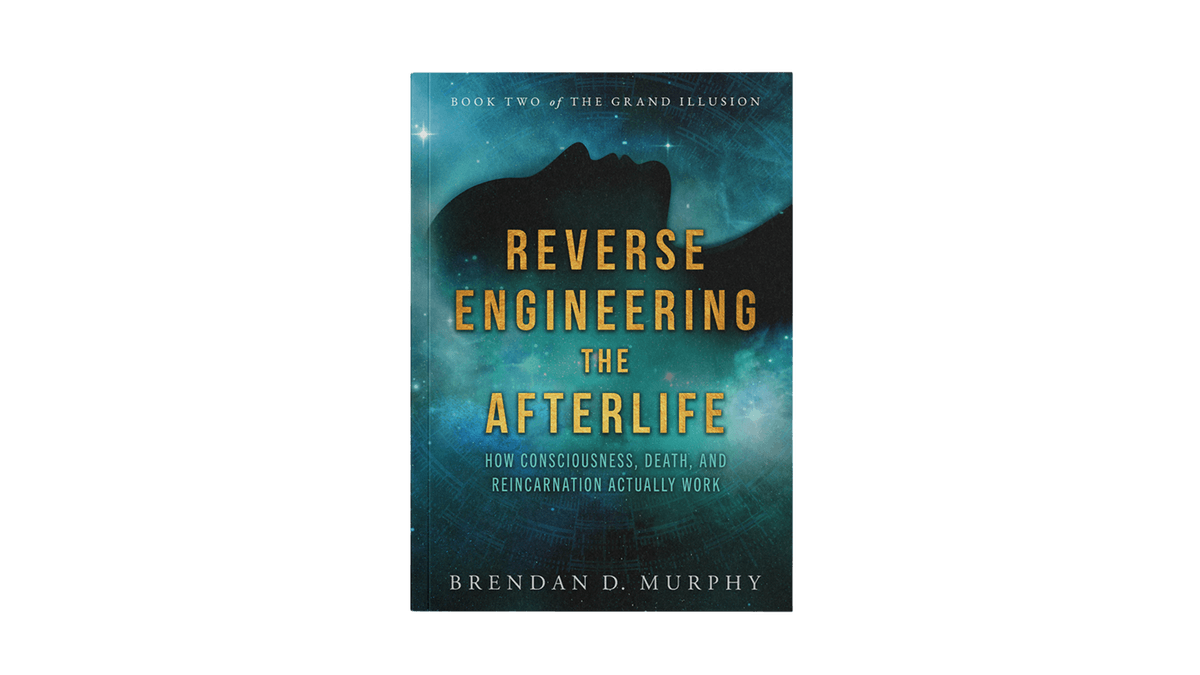
About the author
Brendan D. Murphy
Brendan D. Murphy is a consciousness researcher and author of The Grand Illusion and Reverse Engineering the Afterlife. Working at the intersection of consciousness science, comparative metaphysics, and systems thinking, he maps the architecture of consciousness and post-mortem states without the constraints of religion, materialism, or New Age ideology. He is the creator of the Consciousness Transition Model—the first structured, cross-tradition framework of how consciousness moves through post-mortem states. He publishes regularly on Substack and is based in México.
More about Brendan →