Materialized Spirits: What Physical Mediumship Evidence Implies About Post-Mortem Consciousness
Physical mediumship scientific evidence reviewed—from Gambier Bolton's seven-year weighing experiments to William Crawford's ectoplasm force measurements to Charles Richet's Nobel-preceded materialization research. What the instrumental record actually shows.
The physical mediumship scientific evidence spans more than a century of documented instrumental research—measurable weight loss in mediums during materialisation, photographed ectoplasmic structures, mechanical force measurements, and testimony from researchers including a Nobel laureate. The phenomena were not anecdotal. They were weighed, photographed, and instrumentally measured by credentialed investigators who had begun as committed sceptics. What they found could not be explained by any conventional physical mechanism.
Gambier Bolton Spent Seven Years Establishing That Materialisation Is a Measurable Physical Process
Gambier Bolton was a naturalist—not an occultist—who brought the methodological instincts of field science to the investigation of physical mediumship. Over seven years he conducted rigorous experimental sessions with six different mediums, including Florence Cook, whose work had already been investigated by the physicist Sir William Crookes. Bolton's working principle, as he described it, was "trust no one": every experiment was designed on the assumption that fraud was possible and every claimed phenomenon had to survive attempts to replicate it under conditions that excluded deception.¹
In his 1919 book summarising this work, Bolton concluded:
"The apparently impossible has been proved to be possible…[T]hese materialised entities can manifest themselves today to any person who will provide the conditions necessary for such a demonstration…[O]f their actual existence in a sphere just outside our own, there can no longer be any room for doubt."¹
One of his most structurally important findings concerned experimental conditions. The common assumption that physical mediumship requires darkness—and the associated sceptical objection that darkness enables fraud—was directly contradicted by the evidence. Florence Cook, one of Bolton's principal subjects, insisted on well-lit conditions out of genuine personal fear of working in darkness. The materialisations occurred regardless. The dark-room requirement was not evidential necessity but the preference of some mediums and investigators accustomed to earlier practices.
The most instrumentally significant finding from Bolton's series was the weight measurement during materialisation. Using a self-registering weighing machine, Bolton documented a weight loss of 65 pounds in the medium while a materialised entity stood in their midst. The implication was direct: the manifesting entity was not an apparition or a hallucination. It had measurable physical mass, and that mass was being temporarily drawn from the medium's own physical system. Bolton identified this as the spirit borrowing etheric matter from the medium to such an extent that detectable weight loss actually occurs.¹
This is not subjective testimony. It is a physical measurement—the kind of result that, in any other field of inquiry, would demand serious scientific attention.
Sir William Crookes Investigated the Evidence and Could Not Dismiss It
Sir William Crookes (1832–1919) is not a peripheral figure in the history of science. He invented the radiometer and the Crookes tube—the precursor to modern cathode ray tubes and X-ray technology. He discovered the element thallium. He was elected a Fellow of the Royal Society in 1863 and served as its President from 1913 to 1915. He was awarded the Order of Merit in 1910. He was, by any reasonable measure, one of the most accomplished experimental physicists of the nineteenth and early twentieth centuries.
He was also not credulous. His initial motivation for investigating physical mediumship was specifically to debunk it. He expected to find fraud. What he found instead drove him to publish conclusions that damaged his scientific reputation for the remainder of his career—and which he never retracted.
His investigation of Daniel Dunglas Home—conducted with multiple independent witnesses—documented phenomena that the full body of materialist science has never satisfactorily explained: objects moving without physical contact, Home levitating and floating horizontally through the air, a 70-pound accordion playing itself while Crookes held it by one end in a wire cage, written messages appearing on sealed paper, hands materialising and dematerialising, and Home handling red-hot coals without injury and transferring this immunity to others.²
What concerns us here is the broader pattern. After his investigation of Home, Crookes investigated Florence Cook—and documented, on multiple occasions, the full materialisation of a separate human form, "Katie King," who walked, spoke, and allowed herself to be examined physically while Cook remained separately present in a cabinet. Crookes conducted this investigation over a three-year period, took photographs, made detailed notes, and concluded that the phenomena were genuine.³
Crookes was not the only credentialed scientist to reach this conclusion. He was, however, the one whose existing scientific reputation made the institutional silence most difficult to justify.
William Crawford's Instrumental Measurements Documented Force Transmission During Physical Mediumship
William Jackson Crawford (1881–1920) was a lecturer in mechanical engineering at Queen's University Belfast—a trained engineer with a specific interest in how physical forces operate. Between 1914 and 1920 he conducted systematic instrumental investigations of physical mediumship, focusing primarily on the Goligher Circle in Belfast, which produced table levitations and other physical effects under his observation.
Crawford's approach was methodologically rigorous. He introduced spring balances, weighing platforms, and cantilever measurements to determine whether the observed physical effects involved measurable force transmission. His findings were consistent across hundreds of sittings: the physical effects—levitations, movements of objects, rapping sounds—were accompanied by measurable weight changes in the medium and, in some cases, in the sitters.⁴
Crawford concluded that the physical effects were produced by what he called "psychic structure"—rods or cantilevers of a substance extruded from the medium's body that transmitted mechanical force to the objects being moved. He photographed this substance and measured its mechanical properties. His three published books on the subject—The Reality of Psychic Phenomena (1916), Experiments in Psychical Science (1919), and The Psychic Structures at the Goligher Circle (1921)—constitute the most technically detailed instrumental investigation of physical phenomena produced by any researcher in this field.⁴
Crawford's engineering background gave his analysis a specificity unusual in the psychical research literature. He was not describing experiences. He was measuring forces, calculating lever arms, and quantifying weight transfers. The phenomena he documented were physical in the most literal sense—they registered on instruments designed to detect physical forces—and they could not be accounted for by any mechanism available to conventional physics.
Charles Richet's Research Added Nobel-Level Authority to the Materialization Evidence
Charles Richet (1850–1935) won the Nobel Prize in Physiology or Medicine in 1913 for his discovery of anaphylaxis. He was, at the time he began his serious investigations into materialization mediumship, one of the most eminent physiologists in the world. His Nobel preceded his psychical research publications by a decade—he did not receive the prize because of this work, and the distinction matters. He was not a marginal figure who drifted toward fringe topics. He was a credentialed scientist of the highest rank who brought his professional standards to an investigation he had not sought and whose conclusions he initially resisted.
Richet investigated materialisation phenomena across multiple mediums and multiple countries over several decades. His findings were published in Thirty Years of Psychical Research (1923) and in the photographic documentation compiled as part of the German researcher Baron Albert von Schrenck-Notzing's Phenomena of Materialisation (1923).⁵ The latter volume contains over two hundred photographs of ectoplasmic structures produced under controlled conditions by the medium Eva C. in sessions attended by multiple witnesses, including Richet. The photographs document a substance extruded from the medium's body that takes on the appearance of faces, hands, and partial forms.
Richet wrote: "I shall not waste time in stating the absurdities, almost the impossibilities, from a psycho-physiological point of view, of this phenomenon. A living being, or living matter, formed under our eyes, which has its proper warmth, apparently a circulation of blood, and a physiological activity—and this living matter appears suddenly, fully formed…I am obliged to state what I see without any prejudice."⁵
This is the language of a scientist who has been compelled by evidence against his inclination—not the language of a credulous enthusiast.
Schrenck-Notzing's own investigations in Munich, conducted across hundreds of sessions with multiple mediums and using photography as primary documentation, produced a systematic record of ectoplasm physical mediumship research that has never been satisfactorily addressed by mainstream science. The photographs were taken under controlled conditions, by multiple independent photographers, in sessions where standard anti-fraud precautions were in place. The substance documented does not resemble any known biological material and does not behave according to any known physical principle.⁶
The Pattern Across Investigators Is Too Consistent to Dismiss as Coincidence
What is evidentially significant about the physical mediumship history evidence is not any single investigation but the pattern across them. Bolton, Crookes, Crawford, Richet, and Schrenck-Notzing were not associates. They worked in different countries, in different decades, with different mediums, using different methodologies. They came to their investigations with varying degrees of scepticism—several, including Crookes and Richet, with active hostility to the idea that such phenomena were possible.
They arrived at structurally convergent conclusions: that a physical substance is extruded from the medium's body during materialisation sessions, that this substance has measurable physical properties (mass, temperature, mechanical force), that it can temporarily constitute a form indistinguishable from a living human body, and that no conventional physical mechanism accounts for any of it.
The standard sceptical response—fraud—does not survive contact with the specific experimental conditions. Crawford's spring balances and cantilever measurements were not susceptible to sleight of hand. Bolton's self-registering weighing machine could not be fooled by theatrical staging. Richet and Schrenck-Notzing's photographic sessions involved multiple witnesses, controlled conditions, and body searches of the medium before sessions. Not all physical mediumship investigations were conducted with equal rigour, and the field does contain genuine cases of fraud. But the strongest documented cases were not fraudulent—they were simply inconvenient.
The absence of serious scientific engagement with this body of evidence is not a refutation of it. It is an institutional response to material that threatens foundational assumptions. As with the NDE veridical perception literature, the OBE laboratory research, and the reincarnation case database, the evidence for materialized spirits exists and is substantial. The failure to engage with it is a failure of institutional science, not a failure of the data.
What Physical Mediumship Evidence Implies About the Nature of Consciousness and Death
The physical mediumship scientific evidence, taken on its own terms, suggests something specific and structurally important: discarnate consciousness—consciousness operating outside a living physical body—can, under the right conditions, temporarily construct a physically manifested form. That form has measurable mass. It has temperature. In the strongest documented cases, it has recognisable features, speaks, and responds to questions. It is then dissolved.
This is not metaphor. It is a reported physical process with instrumental correlates. If the process is real—and the instrumental record gives us no other honest conclusion—then several things follow.
First, consciousness survives physical death in some operative form. It has not been extinguished. It retains sufficient coherence and identity to manifest, communicate, and be recognised.
Second, the physical body is not the primary vehicle of consciousness. The materialisation process as described by both Bolton and Crawford involves the borrowing of etheric matter from the medium—a transfer of subtle-body material that temporarily constitutes a denser form. This presupposes that the subtle body exists as a real physical substrate, not as a metaphysical abstraction, and that it can be drawn on as a resource.
Third, the boundary between physical and non-physical is permeable under specific conditions. This is not a revolutionary claim in the context of quantum physics—the vacuum is not empty and the distinction between matter and field is not absolute—but it is a claim that mainstream materialist science has refused to operationalise in the context of consciousness research.
The Consciousness Transition Model maps precisely this territory. The CTM's account of post-mortem consciousness is built on the premise that physical reality is one operational context among several—one Consciousness Operating Environment among a structured hierarchy. The materialisation phenomenon, in CTM terms, is the temporary projection of a post-mortem consciousness from its non-physical Consciousness Operating Environment into the densest available substrate: the etheric field of a living medium. It is not a violation of natural law. It is consciousness operating at the interface between operational contexts—the same interface the CTM maps structurally across NDE research, OBE experiments, and cross-tradition esoteric documentation.
The evidence Bolton, Crookes, Crawford, Richet, and Schrenck-Notzing assembled was not assembled to support a metaphysical framework. It was assembled to test whether the phenomena were real. Their conclusion—that they were—is the starting point for understanding what they mean.
"The apparently impossible has been proved to be possible…Of their actual existence in a sphere just outside our own, there can no longer be any room for doubt."—Gambier Bolton, Ghosts in Solid Form, 1919
Frequently Asked Questions
What is physical mediumship and is there scientific evidence for it?
Physical mediumship refers to the production of observable physical phenomena—object movements, materialisations, measurable weight changes, luminous effects—through a medium, attributed to the influence of discarnate consciousness. The physical mediumship scientific evidence includes instrumental measurements by William Crawford (mechanical force quantification at Queen's University Belfast), weighing machine documentation by Gambier Bolton (65-pound weight loss in mediums during materialisation), and photographic documentation in controlled sessions by Charles Richet and Baron von Schrenck-Notzing. These were not anecdotal accounts—they were instrumental findings produced by credentialed researchers.
Who was Gambier Bolton and what did his research find?
Gambier Bolton was a naturalist who conducted seven years of rigorous experimental investigation of physical mediumship with six mediums, including Florence Cook, following up on the work of Sir William Crookes. Working from an explicit "trust no one" empirical baseline, Bolton documented materialisation phenomena occurring in well-lit conditions, measured a 65-pound weight loss in a medium during a materialisation session using a self-registering weighing machine, and concluded that materialised entities exist in "a sphere just outside our own." His findings were published in Ghosts in Solid Form in 1919.
What did Sir William Crookes find in his physical mediumship investigations?
Sir William Crookes—inventor of the radiometer and Crookes tube, discoverer of thallium, Fellow and President of the Royal Society—conducted extensive investigations of physical mediumship beginning in the 1870s. His investigation of Daniel Dunglas Home documented levitation, object movement without physical contact, accordion self-playing, and materialisation of hands. His investigation of Florence Cook documented the full materialisation of a separate human form over a three-year period. Crookes concluded the phenomena were genuine and never retracted this conclusion. His scientific reputation suffered for it. The phenomena were never refuted.
What is ectoplasm and has it been scientifically documented?
Ectoplasm is a term coined by Charles Richet—from the Greek ektos (outside) and plasma (formed material)—to describe the substance observed to extrude from mediums' bodies during physical materialisation sessions. The scientific documentation includes Baron von Schrenck-Notzing's Phenomena of Materialisation (1923), which contains over two hundred photographs taken under controlled conditions with multiple witnesses and standard anti-fraud precautions, and William Crawford's instrumental measurements of its mechanical force properties at Queen's University Belfast using spring balances and cantilever gauges. It does not resemble any known biological material and does not behave according to any known physical principle.
The esoteric literature—which had been describing this phenomenon for decades before Richet named it—identifies ectoplasm specifically as extruded matter from the medium's etheric body: the semi-physical subtle body that bridges the physical organism and the higher non-physical vehicles of consciousness. Helena Petrovna Blavatsky, whose The Secret Doctrine (1888) synthesised Eastern and Western occult cosmology, described the linga sharira (the astral double or etheric counterpart) as an exact but subtler replica of the physical body, composed of matter at a finer vibrational rate than ordinary physical substance.⁹ It is this vehicle—the one closest in density to physical matter—that the materialisation process draws upon.
Annie Besant and Charles Leadbeater, whose combined investigations into the subtle body structure were published in The Etheric Double (Arthur Powell's compilation, 1925) and The Inner Life (Leadbeater, 1910), described the etheric double as a violet-grey, semi-luminous mist of a finer order of matter than the physical, interpenetrating the physical body and extending slightly beyond it.¹⁰ Leadbeater observed clairvoyantly that during physical mediumship the etheric matter of this vehicle was drawn outward from the medium's body—particularly through specific centres—and used as the substrate for temporary physical manifestation. The weight loss documented by Bolton in his weighing machine experiments is, on this account, the measurable physical correlate of exactly this process: etheric matter temporarily vacating the physical system, reducing its measurable mass, and constituting the manifesting form.
In the Theosophical seven-principle model of the human constitution—drawn from Hindu metaphysics and systematised by Blavatsky, Besant, and Leadbeater—the etheric body (Linga Sharira or Vehicle of Vitality) is the second principle, immediately above the dense physical. It is relatively immobile compared to the astral body, closely tied to the physical organism, and normally discarded within minutes to weeks following biological death. Its role as the ectoplasmic substrate in materialisation is consistent with its position in the hierarchy: it is the semi-physical vehicle most susceptible to interaction with dense physical matter, and thus the one that can be temporarily extruded to form a physically measurable presence.¹¹
Jay Alfred, whose dark plasma model of the subtle bodies is developed in Between the Moon and Earth and is extensively cited in contemporary consciousness research, frames the etheric body as a plasma-based sheath operating at a density intermediate between physical matter and the higher astral plasma shells—a characterisation that aligns structurally with Blavatsky and Leadbeater's earlier descriptions while grounding them in the physics of ionised matter.¹² The ectoplasm documented in Bolton and Crawford's experiments, on this account, is not an unknown substance but a known one: the semi-physical plasma sheath of the medium's etheric double, temporarily externalised under the specific conditions that physical mediumship creates.
How does physical mediumship evidence relate to life after death?
The physical mediumship scientific evidence implies specifically that discarnate consciousness—consciousness operating outside a living physical body—can, under certain conditions, construct a temporarily manifested physical form with measurable mass and temperature. If this is accurate, it means consciousness survives physical death in an operative form that retains sufficient coherence to manifest, communicate, and be physically measured. Combined with NDE veridical perception research, reincarnation case documentation, and controlled mediumship research, the materialisation evidence forms part of a convergent body of data that mainstream science has not refuted—only declined to engage with.
What is the Consciousness Transition Model's explanation for physical mediumship?
The Consciousness Transition Model frames the materialisation phenomenon as consciousness operating at the interface between operational contexts—specifically, a post-mortem consciousness temporarily projecting from its non-physical Consciousness Operating Environment into the densest available substrate: the etheric field of a living medium. The borrowing of etheric matter documented by Bolton and Crawford is, in CTM terms, a transfer of subtle-body material that temporarily constitutes a denser operational form. The CTM does not treat this as a violation of natural law but as a consequence of the permeable boundary between the physical Consciousness Operating Environment and the post-mortem operational states that adjoin it.
The physical mediumship evidence assembled by Bolton, Crookes, Crawford, Richet, and Schrenck-Notzing does not permit easy dismissal. These were not spiritualist enthusiasts reporting impressions. They were working scientists using instrumented measurement to document physical effects that registered on spring balances, weighing platforms, and photographic plates. The instrumental record exists. It has not been refuted—it has been ignored.
What the evidence implies is structurally unavoidable: consciousness survives physical death in an operative form capable of temporary physical manifestation. The next step is not to prove that—the record already does—but to build a coherent model of what that survival looks like. The Consciousness Transition Model is that model.
References
- Bolton, G. Ghosts in Solid Form. William Rider & Son, 1919.
- Crookes, W. Researches in the Phenomena of Spiritualism. J. Burns, 1874. See also: Crookes, W. (1874). Notes of séances with D.D. Home. Proceedings of the Society for Psychical Research, 6, 98–127.
- Crookes, W. (1874). Miss Florence Cook's mediumship. The Spiritualist, January 1874.
- Crawford, W.J. The Reality of Psychic Phenomena. John M. Watkins, 1916. Crawford, W.J. Experiments in Psychical Science. John M. Watkins, 1919. Crawford, W.J. The Psychic Structures at the Goligher Circle. John M. Watkins, 1921.
- Richet, C. Thirty Years of Psychical Research. Macmillan, 1923. See also: Schrenck-Notzing, A. von. Phenomena of Materialisation. Kegan Paul, Trench, Trübner & Co., 1923.
- Schrenck-Notzing, A. von. Phenomena of Materialisation. Kegan Paul, Trench, Trübner & Co., 1923.
- Zöllner, J.C.F. Transcendental Physics. W.H. Harrison, 1882.
- Lodge, O. Raymond, or Life and Death. Methuen, 1916.
- Blavatsky, H.P. The Secret Doctrine, Vol. I & II. Theosophical Publishing Company, 1888. See also: Blavatsky, H.P. Isis Unveiled. J.W. Bouton, 1877.
- Leadbeater, C.W. The Inner Life. Theosophical Publishing House, 1910. Powell, A.E. The Etheric Double. Theosophical Publishing House, 1925.
- Besant, A. & Leadbeater, C.W. The Seven Principles of Man. Theosophical Publishing Society, 1892. See also: Powell, A.E. The Astral Body. Theosophical Publishing House, 1926.
- Alfred, J. Between the Moon and Earth. Lulu Press, 2006.
Explore Further
→ The Consciousness Transition Model — The first structured, cross-tradition map of how consciousness moves through post-mortem states.
→ Testing the Astral Projectors: What OBE Experiments Proved About Consciousness — The controlled laboratory evidence that something leaves the body.
→ Why Science Has Failed the Paranormal Evidence — The institutional reasons the evidence is suppressed.
→ What NDE Research Actually Shows — The near-death evidence base and what it implies for consciousness survival.
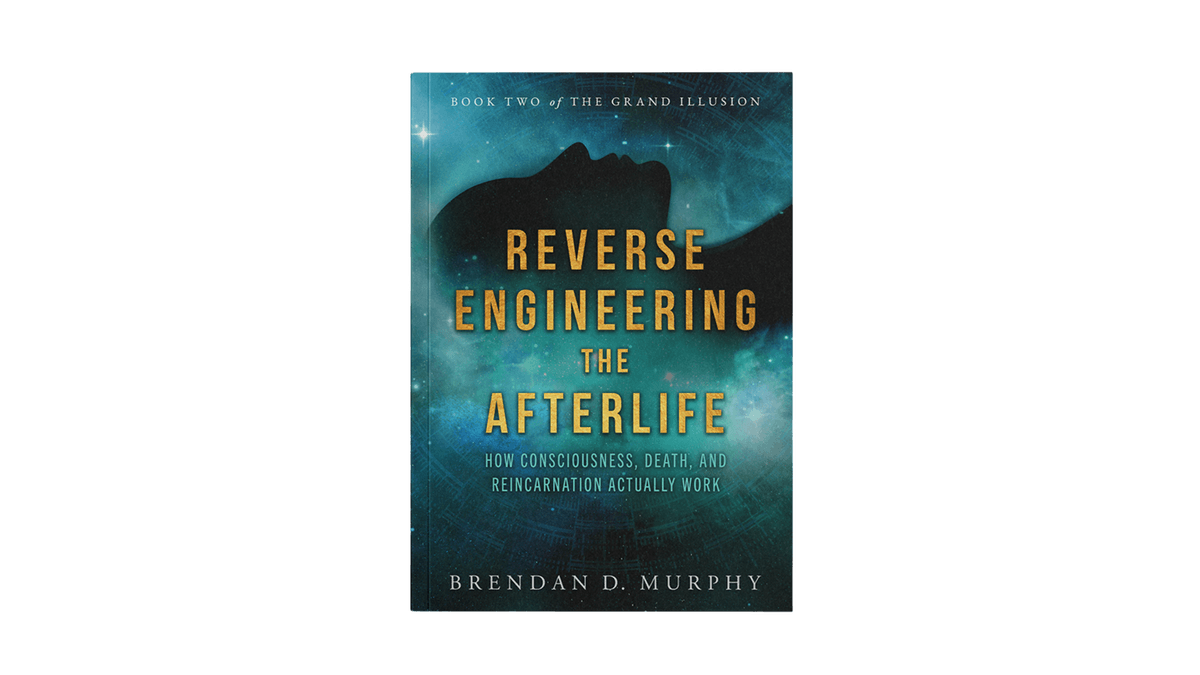
→ Reverse Engineering the Afterlife — Book 2: the full CTM account of post-mortem consciousness states.
Brendan D. Murphy
Reverse Engineering the Afterlife
The full CTM account—post-mortem mechanics, substrate independence, and the structural map of what comes next.
Pre-Order Now →