Do Near-Death Experiences Only Feature Jesus? What the Cross-Cultural and Life-Between-Lives Evidence Actually Shows
No—near-death experiences do not only feature Jesus. Named appearances of Krishna, Buddha, Yama, ancestors, and culturally specific psychopomps are well documented, alongside cases where contacted spirits were directly asked about Jesus and denied knowing the name. The figure encountered tracks the dying person's own cultural background, not a universal recognition of one historical saviour.

Consciousness researcher and author of The Grand Illusion and Reverse Engineering the Afterlife.
Recently I've seen some Christians claiming:
"People only ever report seeing Jesus in NDEs, not other gods, deities, saviours. Why do you think that is?"
The implication of this claim is that near-death experiences (supposedly) converging on one specific figure—the Biblical Jesus—is itself evidence that this figure, and by extension the Christian account of the afterlife, is objectively real and should be believed in.
However, the first problem that arises is that the claim rests on a sampling error, not a fact. "People only ever report Jesus" is false on its face—my manuscript documents named appearances of Krishna, Buddha, Yama/Yamadoots, ancestors, and culturally-specific psychopomps, plus multiple cases where contacted spirits were asked about Jesus and explicitly denied knowing the name. The pattern the actual data shows is the opposite of what the Christian is claiming: in reality, the figure encountered tracks the dying/experiencer's own cultural embeddedness, experience, knowledge, and expectation—not some universal recognition of one historical saviour.
Below is a selection of relevant data points in the manuscript of REVERSE ENGINEERING THE AFTERLIFE, organised thematically and quoted verbatim, with each claim's source noted beside it.
This isn't meant to read as a mere refutation of exoteric Christian dogma. That's a sub-layer the book incidentally contains, given the comprehensive nature of the research behind it. Across the first two volumes of The Grand Illusion, I have drawn on over 500 discrete subjects, some 180 academic disciplines, around 75 professional fields, and over 60 wisdom and religious traditions—from near-death research and esoteric traditions to depth psychology, physics, and systems thinking.
Where most authors survey a handful of fields—and most academics specialise even more narrowly—this work triangulates across incompatible domains, filters for structural convergence, and builds something in the direction of a functional model (The CTM) rather than just another recycled worldview (religious or otherwise).
The resulting findings are guaranteed to raise your eyebrows more than once.
Okay, let's get to stress-testing the claims about NDEs "only" surfacing "Jesus."
1. Direct counter-evidence—spirits denying Jesus, and other named figures appearing instead
The Bishop Pike case is one of the clearest tests on record. Bishop James Pike, a famous mid-20th-century clergyman, made contact with his dead son Jim through medium Ena Twigg and directly asked whether Jim had seen Jesus:
"When Bishop James Pike, a famous clergyman in the mid-1900s, made contact with his dead son Jim through the medium Ena Twigg, he asked him if he had seen Jesus: Jim replied that there was no one by that name, and he had never heard it mentioned. He also added that nothing he had seen on the other side made him any more inclined to believe in God." [fn. 1109, citing Agostini, Death…, 167–171]
My conclusion: "The purpose of the spirit world is not to recruit people into blinkered earthbound theologies. Life-between-lives regressions also uniformly show an absence of deities and saviours of organised religion—such things are relevant only to the earthbound personality application layer, not to the deeper architecture of consciousness itself."
Pike's case is the single most direct rebuttal available: a specifically-asked, specifically-answered test case, and the answer was no one by that name.
Mellen-Thomas Benedict's NDE—Jesus, Buddha, and Krishna together, as interchangeable archetypes. Benedict, travelling toward the light during his NDE, paused to ask questions and:
"saw the brilliant light transform into several avatars, or idealised spiritual archetypes, such as Jesus, Buddha, and Krishna, following which he experienced 'infinite knowledge.'" [fn. 855, citing Williams, Nothing Better Than Death, 55]
If the being of light were actually a specific deity recognising itself as such, why would it cycle through three different culturally-bound faces in one experience?
Bruce Moen's "Sylvia" case—the light being's appearance adjusted to match the dying person's belief, in real time. A deceased woman, Sylvia, was confused about her own death. As a Light Being approached to guide her onward:
"she realised that (according to her beliefs) Jesus was now supposed to come and take her away... an oval of brilliant yellow-white light—a 'Light Being' or 'graduate'—had been approaching from a distance, and as it got closer its appearance adjusted to match her belief, producing, as Moen recalled, the 'best likeness of a Sunday school Jesus I've ever seen.'" [fn. 859, citing Moen, Voyage Beyond Doubt, ch. 14]
My gloss based on the full case material: "Moen's report makes it clear that the light being took on a form that would reassure Sylvia so she could proceed on to the appropriate afterlife destination with some gentle coaching." This is a documented case of the same entity presenting as a generic light-form to one person and "Jesus" to another—the figure is produced to fit the perceiver, not perceived as fixed fact.
Entities do not spontaneously self-identify as Jesus—people interpret them that way. Discussing cases where a friendly discarnate presence (e.g. a deceased spouse) gets misread as a religious figure, the manuscript states plainly:
"people can misinterpret the appearance of a friendly intelligence (such as a deceased spouse) in an NDE or a vision as an 'angel,' 'Jesus,' or even something malicious—the Misidentification Principle at work... And please note the entity never identifies itself as Jesus either—it is human minds doing that creative work." [p. 176]
Physicist Fred Alan Wolf—Jesus and Krishna as interchangeable archetypes of the same underlying thing:
"On a higher level, everyone embodies the archetypal aspects of Jesus, Krishna…etc. These archetypes of our ideals heal our sense of soul loss and serve our spiritual revival to help us remember a part of us that we usually forget about in everyday life." [fn. 849]
Wolf is correct. When people start to grasp who "they" are at higher tiers of consciousness states, Wolf's very apropos statement will make more sense.
Devotional heaven-worlds are populated by worshippers of Krishna, Vishnu, and Shiva, and the Virgin Mary, just as much as by worshippers of Jesus—Robert Monroe (and others) mapped all these realms and dubbed them Belief System Territories. Charles Leadbeater's clairvoyant research on the afterlife revealed:
"Worshippers of Vishnu, Krishna, Jesus, the Virgin Mary, and a few of Shiva may be found here, each wrapped in their own bubble of thought, alone with their god." [fn. 1893]
Thai NDEs: when asked to see "the being of light," subjects are shown the Buddha instead—as a star. In a case cited from Todd Murphy's Thai research:
"the experient asked the Yamatoot to take him to see Lord Buddha, but the Yamatoot only pointed to the sky at a star, saying: 'That big star…is The Buddha. And those little stars are the other enlightened ones…'" [fn. 853]
No Jesus to be found in Thailand either, it seems.
2. Cross-cultural NDE research: the figure encountered tracks culture, not truth
This is perhaps the strongest structural rebuttal—large, systematic, peer-reviewed studies showing deity content varies by the dying person's background while the underlying architecture of the experience stays constant.
Osis & Haraldsson's landmark cross-cultural deathbed study (1977), ~900 cases, India vs. USA:
"Karlis Osis and Erlendur Haraldsson's 1977 huge cross-cultural study of deathbed visions with Indian and American medical professionals featured nearly 900 cases, finding that the form of the NDE was similar across cultures though specific content varied with cultural conditioning. Indians were less inclined to depart peacefully—beings arriving to escort them (sometimes family members) were often resisted ('I will not go with you!') and feared. Gods and goddesses featured more frequently in Indian deathbed visions, including the Yamdoots—'angels of death' who can terrify and rudely drag the reluctant dying party into the hereafter. Westerners, by contrast, rarely report being terrified of the beings of light who come to welcome them." [fn. 810, citing Grosso, Experiencing the Next World Now, 39-40]
Dr Gregory Shushan, Near-Death Experience in Indigenous Religions—the explicit thesis that content varies by region while the phenomenon itself is universal:
"while NDEs are universal, how they are actually experienced and interpreted varies by region and culture. As the historical documents reveal, in North America, they were commonly valorised... In Africa, however, they were largely considered aberrational events with links to possession or sorcery... Oceania, Micronesia corresponded more to the African model, while Australia had a greater focus on afterlife journey shamanism. Polynesia and Melanesia showed an almost casual acceptance of the phenomenon." [fn. 807]
Evans-Wentz on the Tibetan Book of the Dead—explicitly stating different religions populate the death-state with their own figures:
"the bardo states/perception during the transitional stages of death would be populated by culturally determined thought-forms (Hindus would have their own, just as Muslims and Christians would, and so on)." [fn. 808]
Satwant Pasricha's India/America comparison found religious figures more common in India, and a culturally-specific judge-with-a-book replacing the Western life review:
"Key differences noted by Pasricha included: the subject being 'taken to other realms by messengers or some one' and then being 'passed on to the man with a book' containing a list of deeds or mistakes... 'just as is done by the god Chitragupta in Hindu mythology.'" [fn. 826–827]
Thailand (Todd Murphy's research)—Yama and his Yamatoots replace the Western "being of light," and the whole template is traced to a specific local text, not a universal truth:
"in all ten of Murphy's Thai NDEs, the most common initial phase was a visitation by a Yamatoot, one of Yama's servants... Murphy concludes that, like other cultures, Thai NDEs are pre-programmed via expectation, specifically stemming from Thailand's highly homogeneous religious matrix... The Phra Malaya is the only important source of Thai ideas and expectations about death and dying." [fn. 831–836]
One Thai case even catches the Yama-figure consulting a book with a clerical mix-up—the wrong soul had been collected—and the error is later verified against an actual death:
"The patient 'sneaked' a look into [Yama's] book, and he saw that it was written in Thai... he saw the name of a person he knew from his village, with the date of his death written as three days after his own NDE. The man named in Yama's book did, in fact, die on the date named." [fn. 811]
Japan (Yamamura, 1998; Tachibana study of 243 cases)—no tunnel for most non-white groups, imagery drawn from Japanese cultural motifs:
"Japanese NDErs—like most other non-white ethnic groups—did not report a tunnel experience... Tachibana's study of 243 NDEs confirmed that Japanese NDErs often reported 'seeing long, dark rivers and beautiful flowers, two common symbols that frequently appear as images in Japanese art.'" [fn. 812–813, 822]
Iran (Fracasso et al., 2010, 19 Iranian Muslims)—structurally similar to Western NDEs, but with Islamic religious figures, not Jesus:
"A 2010 study by Fracasso and colleagues of nineteen Iranian Muslims reporting NDEs found the core elements strongly represented: encounters with light (62%)... 21% sensing the presence of deceased relatives and/or religious (holy) spirits... 'both the contents and aftereffects of the Muslim NDEs were quite similar to those of Westerners…NDEs are not particularly rare in Muslim groups and that their similarity to Western NDEs suggests they may be a cross-culturally universal and transpersonal phenomenon.'" [fn. 814]
Libya (Dr Giorgio Fonzo's 1950s–60s case files)—Islamic-world NDEs with no Jesus anywhere in them, including a murderer's hellish NDE with no demons, just isolation:
A Libyan "murderer who survived hanging found himself—perhaps not surprisingly—alone in a gloomy place without light... there were elements that clearly did not fit culturally programmed afterlife expectations (the murderer found himself lonely and deserted instead of tormented by demons, for example)." [fn. 815–816] [His experience is actually not unusual for criminals—initial post mortem isolation is actually predicted.]
Papua New Guinea (Dorothy Ayers Counts, 1983, Melanesian fieldwork)—no OBE, no tunnel, no Jesus, no unitary "soul" concept at all, yet the same basic journey-structure:
"The Melanesian population did not share the concept of a unitary human soul... OBEs and bliss were absent from their NDEs; most walked a path into the next world rather than passing through a tunnel. The mainstays were meeting spirit guides or deceased relatives, entering a bucolic paradisiacal realm, and being told to return by a guide or internal voice." [fn. 818]
Ancient China (Han-era funerary texts)—an entirely secular afterlife bureaucracy modelled on Chinese government, not Jesus or any deity recruiting souls:
According to Shushan, these texts "reveal anxieties about the efficiency of these officials, appealing to them to make sure that they've taken the right person, and at the right time." [fn. 830]
Zoroastrianism independently produces a judgment-at-a-bridge structure with its own named figures (the daena, the judge Meher, the psychopomp Sarosh)—structurally parallel to the Christian and Egyptian versions but populated by entirely different named beings. [fn. 828]
Christian writers sometimes point to non-Western NDErs who report meeting Jesus as a counter to this pattern—most prominently John Burke's Imagine Heaven, which cites a Hindu NDEr who describes meeting Jesus despite her background. Her own words, though, describe "a distant presence of Jesus Christ"—a felt presence, not a being who spoke and named itself—and in the same account she separately encountered her own family's deity in a form that, by the reporting author's own admission, didn't match that goddess's classic depiction. That's not a being announcing its identity; it's the same cultural-conditioning pattern as everywhere else in this piece, just reaching in both directions at once.
3. Why "Jesus" shows up in Western near-death experiences specifically—and why researchers found zero spontaneous cases
This is the section that answers the Christian's question most directly: why do Westerners say "Jesus"? Not because it's true, but because of prior exposure—and even then, veteran researcher Dr Kenneth Ring found zero cases of a being of light actually, spontaneously self-identifying that way. This is one of my own passages from the book:
"Ken Ring—like myself—found precisely zero instances of NDEs wherein the being of light identified itself as 'Jesus.' [fn. 1108, citing Ring, Heading Toward Omega, 87] It is, with very few exceptions, the interpretation of an NDEr whose psyche has already been colonised with Christian theology. Even without conscious belief, exposure to the idea is what counts—it becomes the symbolic schema through which the abstract Imaginal information field is interpreted."
Critics sometimes cite a statistic—roughly a third of Western NDErs who report meeting a divine being call it Jesus—as if that settles the matter. It measures something different from what it sounds like: not a third of beings announcing themselves as Jesus, but a third of experiencers who, afterward, decided to call the being they met Jesus. Ring didn't arrive at his zero-count from a handful of cases either; it came out of decades of NDE research, beginning with his landmark 1980 study and continuing through his later books. The one-third figure and Ring's zero aren't in tension—they're measuring two different things, and once separated, the "Jesus" result turns out to be built entirely out of the first kind of measurement: a third of experiencers reaching for a label, not a third of beings offering one.
In other words: cultural exposure to the Jesus-narrative is sufficient to produce a Jesus-interpretation, whether or not the person consciously believes it—which is the opposite of evidence that the figure encountered is Jesus. It is evidence that human minds, primed with a specific religious schema, label an ambiguous, numinous encounter using the nearest available cultural template. This is stated as a general principle in the book (the "Misidentification Principle," closely related to what the manuscript calls the "Manasic Translation Error"): an NDEr can mistake a deceased relative, or an undefined "being of light," for "an angel," "Jesus," or something else—but, crucially, "the entity never identifies itself as Jesus either—it is human minds doing that creative work."
Some writers go further and claim the encounter itself is reserved for those who've already accepted Jesus. Randy Kay, a popular NDE author, writes that only those who believe in Jesus as Lord and Savior report meeting a being who loves them—but on the same page describes his own encounter as happening while he was, in his words, "a former agnostic." Jesus met him before he'd accepted anything. Howard Storm makes the same point from the opposite direction: a self-described "aggressive atheist hostile to all religion" before his NDE, he only called out to Jesus in desperation, reaching for the one piece of imagery his childhood Sunday school had left in his subconscious—and a being he then interpreted as Jesus appeared and healed him. If the encounter were gated by acceptance, neither man should have gotten one. What determines whether "Jesus" shows up isn't belief—it's exposure, which can sit dormant for decades in someone who has explicitly rejected it. Yolaine Stout's case is sharper still: by her own account she didn't believe in God, Jesus, angels, or an afterlife of any kind before her 1982 NDE, and named the being beside her Jesus anyway once the experience ended—exposure alone was enough, with no childhood religious memory to draw on at all. (Some raise the "angel of light" objection here—that NDE beings might be deceptive rather than benevolent. That's the same accusation that's long been levelled at any being of light not explicitly labelled Jesus, and by its own logic applies equally to Jesus, who is also described as a being of light. This piece works from the pattern in the evidence, not a scriptural argument about which spirits can be trusted.)
The archetype explanation. The manuscript frames Jesus (and equally Krishna, Buddha, Osiris, etc.) as one instance of a pre-existing, pan-cultural pattern—the Saviour archetype—that long predates Christianity:
"You could think of religious deities and heroes such as Christ as archetypes or 'universal' software programs; personifications of major, timeless themes embedded in the potentiality of the Source Field. The Saviour archetype is one of many from pre-Christian traditions, going back at least as far as ancient Mesopotamia."
The same mechanism that produces a "Jesus" is shown, elsewhere in the manuscript, producing thought-forms as mundane as Santa Claus during remote-viewing sessions by US Army psychics—i.e., the mechanism is general-purpose cultural pattern-recognition as the mind anticipates what it might encounter in the Great Unknown, not a channel exclusively tuned to any particular historical figure. [fn. 806]
Even within Christian/culturally-primed NDEs, the "Jesus" figure routinely contradicts or ignores the theology it's supposedly validating. In one widely-cited case (a young Mormon girl's NDE), the figure she called "Jesus" showed up alongside two souls waiting to be reborn—a straightforwardly reincarnational detail with no place in her actual church's doctrine:
"She then met the 'heavenly Father and Jesus,' who asked her if she wanted to return to earth... The tunnel and the border experience are not part of the Mormon afterlife doctrine and the reincarnationist theme is not typical of most NDEs. The Christian interpretational overlay is easily attributed to her cultural preconditioning." [fn. 521]
So even the cases that do produce a "Jesus" label routinely contain content the person's own church would reject—which argues against "the real Jesus validated by NDEs" and for "a generic numinous encounter, labelled by whatever religious vocabulary the person has to hand, which then leaks other non-doctrinal material around the label."
4. Life-between-lives (LBL) regressions: when you go deeper than the surface NDE, Jesus disappears entirely
This is arguably the single strongest category of evidence in the manuscript, because it describes what happens when thousands of subjects are taken past the superficial, culturally-primed layer of the near-death/altered-state experience. Michael Newton's decades of client regressions (documented in Journey of Souls, Memories of the Afterlife, and Wisdom of Souls) are cited repeatedly for one consistent finding: named deities and saviours vanish once the subject passes the "alpha" (surface, consciously-primed) stage and enters deeper "theta" trance states.
"During the earlier alpha stages of hypnosis in LBL sessions, there are subjects who may mention known historical figures on earth whom they relate to on a conscious level. This is…preconditioned conscious interference. But once the deeper theta state of hypnosis is achieved, usually after mentally crossing into the spirit world, symbolic religious figures disappear in favour of the recognition of a personal spirit guide." [fn. 856, citing Newton, Memories of the Afterlife, 212]
The manuscript states this as a general, repeated pattern, not a one-off:
"Life-between-lives regressions also uniformly show an absence of deities and saviours of organised religion—such things are relevant only to the earthbound personality application layer, not to the deeper architecture of consciousness itself." [p. 239]
"gods, messiahs, and saviours are absent in interlife accounts and other afterlife sources." [p. 119]
"Beyond the superficial stages of Western NDEs, saviours, personal gods, and messiahs disappear." [fn. 852]
"this filtering is exemplified in the life-between-lives regression literature where many thousands of people inducted into theta brainwaves have found a total absence of gods, saviours, and other religious constructs, as well as an absence of other more contemporary [pop-culture-derived] themes." [p. 249]
In the manuscript's framing, the Astral Fantasia (the surface layer of the collective unconscious populated by "aliens, demons, Archons, Ascended Masters, archetypes, mythological figures, ancient heroes, saviours, messiahs, deities, Santa Claus, Satan, Lucifer") is explicitly contrasted with the deeper, cross-culturally consistent architecture reached in genuine NDEs and LBL work—and Jesus sits in roughly the same explanatory bucket as Santa Claus: both are real thought-forms generated by collective (and personal) belief, encountered by sufficiently "open" perceivers, but neither is evidence of the literal, historical entity operating as advertised. [p. 249]
5. The interpretive principles the manuscript offers—what the data actually supports
These are the explanatory frameworks I use to explain why NDE content varies by culture while the underlying phenomenon stays constant—useful for answering "why do you think that is?" on its own terms rather than just listing counter-examples.
Cultural embeddedness. Named directly as the governing principle:
"cultural factors do play a role in colouring the NDE (and other mental explorations of the Imaginal information field). This phenomenon has been referred to by scholars in the field as 'cultural embeddedness.'" [p. 177]
Need-serving imagery. The figure/imagery encountered is shaped to serve what the individual psyche needs at that moment, per researcher P.M.H. Atwater:
"the initial imagery encountered in NDEs is need-serving and designed to ensure that whatever needs addressing during the NDE is addressed using the appropriate stimuli for that individual." [fn. 852]
Jung's framework—"God"/"Daimon" as psychological realities, not literal external beings:
"'God' and 'Daimon' are synonyms for the unconscious; they convey the numinosity, the 'otherness,' of the experience... 'Metaphysical assertions…are statements of the psyche, and are therefore psychological.'" [fn. 1110, 809]
The Christian mystic and seer Swedenborg's own testimony (he was also an NDEr) that the afterlife appears according to need, not fixed theological fact:
"the afterlife appears to people the way they need it to appear at the moment of death." [fn. 857]
Structural universality, surface variability—the pattern stated as a general conclusion across NDE databases, hypnotic regression, clairvoyant observation, and OBEs:
"Cross-cultural studies: Show consistent core features with variable symbolic representation... Psychedelic and altered states: Frequently produce entity encounters and environments shaped by expectation and belief. Across these domains the structure remains stable, while the representation varies. This strongly suggests a translation process is occurring, rather than direct perception of objective forms." [p. 584]
This is the key reframe for the conversation: the consistent element across cultures is things like OBE onset, travel to another realm, a life review/moral evaluation, encounter with a divine/numinous presence, profound positive affect, a sense of vastly expanded knowledge, meeting the deceased, and being sent back. The figure's name and face is the variable—Jesus for Christians, Krishna/Vishnu/Shiva (even Om!) for Hindus, the Buddha (even appearing literally as a star) for Thai Buddhists, Yama and his Yamadoots/Yamatoots across the Indic-influenced world, ancestral or village figures in Melanesia, bureaucratic clerks in China. That pattern—constant structure, variable content matching the perceiver's own background—is exactly what you'd expect from a shared human/consciousness phenomenon being interpreted through a cultural lens, and precisely what you would not expect if one specific named deity were the literal, objectively-perceived truth of the afterlife.
6. Veridical NDEs and blind experiencers: what the evidence actually verifies
Veridical NDEs—cases where someone perceives verifiable information they had no ordinary way of accessing—are genuinely some of the strongest evidence in the field, and some Christian writers lean on that evidential weight to back their Jesus claims specifically. One case shows exactly where that reasoning breaks down.
Vicki Umipeg was blind from birth. In her 1997 NDE, documented in Kenneth Ring and Sharon Cooper's study of blind near-death experiencers, she accurately perceived the crumpled wreckage of the car she'd been in, viewed her own body from the ceiling, and correctly identified it as hers by a distinctive wedding ring—details someone blind from birth has no visual vocabulary to invent. That perception is independently verifiable, and it's genuinely impressive.
What happened next in her NDE is a different kind of claim. A being of greater luminosity appeared, and Vicki interpreted it as Jesus—but, per the researchers' own account, the being never identified itself as such. The accuracy that makes her OBE perception compelling evidence has nothing to do with the name she gave the being afterward. One is a verified observation; the other is an interpretation laid over an experience that was, by its nature, wordless. Blind NDErs do sometimes see Jesus—the same way sighted ones do, by supplying the label themselves.
Bottom line
Together the multitude of adjacent data streams don't just rebut the Christian's claim—they invert it: the data shows a consistent underlying architecture dressed in whatever religious clothing the perceiver already knows (regardless of belief), which is the opposite of one religion's figure being uniquely, objectively verified.
Frequently Asked Questions
Do people see Jesus in near-death experiences?
Some Western experiencers report a figure they call Jesus, but the label comes from the experiencer, not the being. Kenneth Ring found zero cases in which the being of light identified itself as Jesus, and in Bruce Moen's Sylvia case a light being adjusted its appearance to match her belief, producing the "best likeness of a Sunday school Jesus I've ever seen."
Do people of other religions see their own figures in NDEs?
Yes. Osis and Haraldsson's study of nearly 900 deathbed cases found gods, goddesses and the Yamdoots more often in Indian visions. In Todd Murphy's Thai research, NDEs opened with a Yamatoot, one of Yama's servants. Fracasso's Iranian Muslim experiencers sensed deceased relatives and holy spirits, not Jesus, and Satwant Pasricha found a judge with a book echoing the Hindu god Chitragupta.
Do NDEs prove Christianity?
No. Across cultures the structure stays constant—out-of-body onset, travel to another realm, a life review, a numinous presence, meeting the deceased, being sent back—while the figure's name and face match the perceiver's own background. That is what you'd expect from a shared phenomenon interpreted through a cultural lens, not from one religion being objectively verified.
Do people see God in near-death experiences?
An encounter with a divine or numinous presence is one of the consistent core features of near-death experiences across cultures. What varies is the form it takes: Jesus for Christians, Krishna, Vishnu or Shiva for Hindus, the Buddha (even appearing as a star) for Thai Buddhists, and ancestral or village figures in Melanesia.
What do life-between-lives regressions show about Jesus?
In Michael Newton's life-between-lives regressions, subjects may mention known religious figures during the lighter alpha stages, but once the deeper theta state is reached, "symbolic religious figures disappear in favour of the recognition of a personal spirit guide." Across many thousands of subjects, gods and saviours of organised religion are absent.
References
Show 24 references
- Murphy, B.D. Reverse Engineering the Afterlife (The Grand Illusion—Book 2). Forthcoming.
- Agostini, M. (2003). Death: The Ultimate Orgasm?, pp. 167–171.
- Williams, K. (2002). Nothing Better Than Death. Xlibris.
- Moen, B. (1998). Voyage Beyond Doubt. Hampton Roads.
- Osis, K. & Haraldsson, E. (1977). At the Hour of Death. Avon.
- Grosso, M. (2004). Experiencing the Next World Now. Paraview Pocket Books.
- Shushan, G. (2018). Near-Death Experience in Indigenous Religions. Oxford University Press.
- Evans-Wentz, W.Y. (ed.) (1927). The Tibetan Book of the Dead. Oxford University Press.
- Pasricha, S. & Stevenson, I. (1986). Near-death experiences in India: A preliminary report. Journal of Nervous and Mental Disease, 174(3), 165–170.
- Murphy, T. (2001). Near-death experiences in Thailand. Journal of Near-Death Studies, 19(3), 161–178. https://digital.library.unt.edu/ark:/67531/metadc799340/
- Tachibana, T. (1994). Rinshi Taiken [Near-Death Experience], vols. 1–2. Bungei Shunjū.
- Fracasso, C., Aleyasin, S.A., Friedman, H. & Young, M.S. (2010). Near-death experiences among a sample of Iranian Muslims. Journal of Near-Death Studies, 29(1), 265–272. https://digital.library.unt.edu/ark:/67531/metadc461762/
- Counts, D.A. (1983). Near-death and out-of-body experiences in a Melanesian society. Anabiosis: The Journal for Near-Death Studies, 3(2), 115–135. https://digital.library.unt.edu/ark:/67531/metadc798973/
- Burke, J. (2015). Imagine Heaven. Baker Books.
- Ring, K. (1980). Life at Death. Coward, McCann & Geoghegan.
- Ring, K. (1984). Heading Toward Omega. William Morrow.
- Kay, R. I Died And THIS Is What Jesus Revealed To Me. Destiny Image blog. https://www.destinyimage.com/blog/randy-kay-i-died-and-this-what-jesus-revealed-to-me
- Storm, H. (2005). My Descent into Death: A Second Chance at Life. Doubleday.
- Jesus Spoke to Her During Her Near-Death Experience (Yolaine Stout). Guideposts. https://guideposts.org/articles/angels-and-miracles/jesus-spoke-to-her-during-her-near-death-experience/
- Newton, M. (1994). Journey of Souls. Llewellyn.
- Newton, M. (2009). Memories of the Afterlife. Llewellyn.
- Michael Newton Institute (2019). Wisdom of Souls: Case Studies of Life Between Lives. Llewellyn.
- Ring, K. & Cooper, S. (1997). Near-death and out-of-body experiences in the blind: A study of apparent eyeless vision. Journal of Near-Death Studies, 16(2), 101–147. https://digital.library.unt.edu/ark:/67531/metadc799333/
- Ring, K. & Cooper, S. (1999). Mindsight: Near-Death and Out-of-Body Experiences in the Blind. William James Center for Consciousness Studies.
Explore Further
→ What NDE Research Actually Shows — Forty years of near-death data and why the mainstream dismissal fails.
→ Misidentification Principle — Why experiencers label a being with the nearest cultural template.
→ Astral Fantasia — The surface layer where saviours, deities and archetypes appear.
Brendan D. Murphy
Reverse Engineering the Afterlife
The full CTM account—post-mortem mechanics, substrate independence, and the structural map of what comes next.
Pre-Order Now →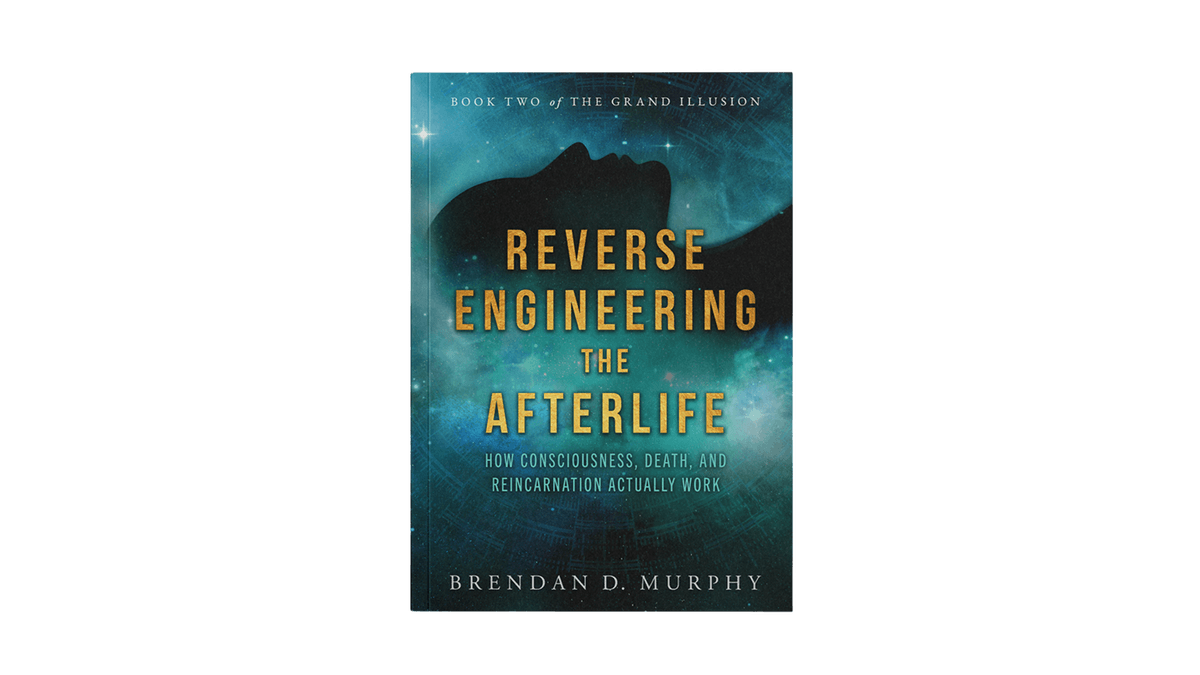
About the author
Brendan D. Murphy
Brendan D. Murphy is a consciousness researcher and author of The Grand Illusion and Reverse Engineering the Afterlife. Working at the intersection of consciousness science, comparative metaphysics, and systems thinking, he maps the architecture of consciousness and post-mortem states without the constraints of religion, materialism, or New Age ideology. He is the creator of the Consciousness Transition Model—the first structured, cross-tradition framework of how consciousness moves through post-mortem states. He publishes regularly on Substack and is based in México.
More about Brendan →