What Happens to Consciousness During a Coma?
During a coma, the biological interface that normally constrains and localises consciousness is severely disrupted. What some patients report—vivid, coherent, emotionally complete alternate lives that feel more real than waking experience—is not random hallucination. The Consciousness Transition Model identifies it as a Constructed Reality Field: an internally generated experiential environment that follows its own coherent logic precisely because the brain's regular filtering function has been temporarily suspended.

Consciousness researcher and author of The Grand Illusion and Reverse Engineering the Afterlife.
The Story Everyone Is Sharing
In May 2026, a story went viral across multiple media channels. A 19-year-old French woman woke from a three-week medically-induced coma convinced she had lived seven years. She had given birth to triplets, lost one, raised the others, gone on family walks, read bedtime stories, had dinner with a husband who doesn't exist. She woke asking to see her babies. She was devastated when told none of it was real.
A similar case appeared on Reddit around the same time: a person sharing that they had lived what felt like a complete alternate life during a coma—a different career, different relationships, a different city—all internally consistent, all emotionally real, all gone the moment they opened their eyes.
Both cases are being discussed widely. The mainstream framing is predictable: confabulation, REM intrusion, the brain fills in gaps. These are not wrong exactly. But they are radically incomplete. They describe a mechanism while missing the most important question: why was the experience so coherent, so emotionally complete, and why does it leave such profound grief?
What Neuroscience Says—and Where It Stops Short
The standard materialist account of coma dreams goes roughly as follows. During a medically-induced coma or severe brain injury, the brain may enter states resembling light sleep or delirium. Fragments of sensory input, memory, and desire get stitched together into narratives. On waking, these narratives are recalled as if they were real because they share the same memory-consolidation pathways as genuine experience. The brain—which dislikes blank spaces—confabulates to fill them.
This account has genuine explanatory power for fragments of some cases. It does not explain the specific structure of the experiences being reported. Confabulation produces fragmentary, inconsistent, internally contradictory narratives. What these coma patients describe is the opposite: sustained, internally consistent worlds with their own emotional logic, relational depth, and temporal coherence across what felt like years. One is a patchwork. The other has the architecture of a life.
The distinction matters. A hallucination is noise that mimics signal. A Constructed Reality Field is signal—generated through a different mechanism than ordinary waking perception, but signal nonetheless.
What the Consciousness Transition Model Shows
The Consciousness Transition Model proposes that the brain is not the source of consciousness but its primary constraint and filtering mechanism during physical life. The nervous system localizes awareness, limits informational bandwidth, enforces sensory grounding, and stabilises identity through continuous external input. This is what produces the stable, consensus-shared reality of ordinary waking life.
When that filtering mechanism is severely disrupted—as it is during a coma—something specific happens. Consciousness doesn't go blank. It doesn't hallucinate randomly. It operates under a different set of conditions: the Incarnation Bandwidth Limitation is temporarily lifted, external sensory anchoring is removed, and the internal generative processes of consciousness—which are always running beneath waking experience—become the primary architects of experiential reality.
The result is a Constructed Reality Field: a structured experiential environment generated through consciousness rather than through external sensory input. It is shaped by memory, emotional content, desire, relational patterns, and the inherent tendency of consciousness to organise experience into coherent narrative. It is also, crucially, Thought-Responsive—the environment responds to and is co-generated by the internal state of the consciousness inhabiting it.
This is not imagination. Imagination is volitional and recognised as distinct from reality. A Constructed Reality Field spontaneously presents itself with the full phenomenological weight of genuine experience, because it is genuine experience—generated through consciousness rather than through sensory data.
A First-Person Account—From the Researcher
The cases circulating online are striking. What follows is closer to home.
In 2020, Brendan had a blood sample taken at a doctor's surgery. He passed out in the chair—common enough in healthy young men. What was not common was what happened next.
There was no gap in experience. No darkness. No sense of absence. He was instantly elsewhere—inhabiting what felt like a completely different life in a completely different, though still earth-like, world. The transition was instantaneous and seamless. The new context felt utterly familiar, entirely coherent, the most natural thing in the world. He knew he had a life there. He continued going about his business: walking through a modern metropolis, on his way somewhere, with the settled sense of someone moving through their own city.
Aimee, seated beside him in the surgery, watched his head fall back and his eyes roll and flutter as if in a seizure. From her vantage point, Brendan was a body in a chair. From inside the experience, there was no body in any chair. His "I"—the locus of awareness—had fully relocated. Brendan D. Murphy and his physical situation were simply not present in consciousness.
This is not a near-death experience. The body was not threatened. It is something more specific: a Constructed Reality Field generated in the moment the brain's anchoring function momentarily failed. The external sensory grounding dropped. Consciousness did not drop with it. It "went somewhere"—or rather, it remained operative and coherent under radically different conditions. The parallel context was not fragmentary or dreamlike. It had the density of ordinary waking reality.
The theoretical question of whether this represents a shift to an alternate probability state—what Monroe termed Locale III—or a fully internally generated environment remains open. What is not open is the phenomenological character of the experience: immediate, coherent, continuous, and real. Exactly what the CTM predicts when the Incarnation Bandwidth Limitation is temporarily suspended.
Why the Grief Is Real
The most striking element of the viral cases online is the grief. The French woman woke asking for her children. The Reddit poster described the loss as real bereavement. This baffles the confabulation model: why grieve a hallucination?
The CTM has a direct answer. The grief is real because the experience was real as experience. A Constructed Reality Field is not less real than waking experience in any phenomenologically meaningful sense. The consciousness that inhabited those seven years actually lived them—not in physical spacetime, but in a fully coherent experiential context that had its own emotional completeness.
When the biological system reasserts itself and that field collapses, what is lost is not a dream. What is lost is a context of existence that had genuine relational depth and emotional integration. The CTM takes that seriously. Neuroscience, by reducing it to confabulation, cannot explain the grief without implicitly admitting the experience had qualities that confabulation actually does not produce.
Terminal lucidity offers an instructive parallel. In terminal lucidity, a brain that has been severely damaged for years suddenly supports coherent, structured consciousness in the final hours of life. The conventional model says this is impossible. The brain-as-filter model says it is expected: when the constraining function relaxes, the consciousness it was constraining operates more freely. The coma case works the same way in reverse: when the brain's organising and anchoring function is temporarily suspended, consciousness doesn't disappear. It builds its own world.
What This Is Not
It is worth being precise about what the CTM is and is not claiming here.
It is not claiming that the coma patient's alternate life was located in an objective external reality. The Constructed Reality Field is generated by consciousness, not discovered as an independently existing world. The husband does not exist. The triplets do not exist. The loss is real; the objects of loss are not external entities.
It is not claiming that consciousness operates with equal clarity and coherence during all coma states. The Awareness Retention Threshold varies. Some patients report nothing. Some report fragments. Some report fully coherent experiential worlds. The variation is consistent with a model in which the degree of experiential coherence depends on the structural coherence and integration of the consciousness undergoing the disruption.
And it is not claiming that consciousness during coma is equivalent to post-mortem consciousness. The coma represents a disruption of the biological interface, not its full and permanent decoupling. Consciousness remains tethered—which is why it returns when the biological system recovers. What it demonstrates is what consciousness does when that tether is dramatically loosened.
"The grief is real because the experience was real. A Constructed Reality Field is not less real than waking experience in any phenomenologically meaningful sense—it is generated through a different mechanism, but the consciousness that inhabited it actually lived it."
Conclusion
When a 19-year-old wakes from a coma devastated that her children don't exist, the correct response is not to explain her grief away with the language of confabulation. The correct response is to take seriously what her experience reveals: that consciousness during a coma is not an absence but an alteration—a shift in the conditions under which consciousness operates, producing experiential realities that are coherent, emotionally complete, and real as experience even when they have no external correlate.
The Consciousness Transition Model offers the only framework currently available that can explain both the coherence of these experiences and the depth of the grief that follows them.
Frequently Asked Questions
What happens to consciousness during a coma?
During a coma, the brain's normal function as a constraint and filtering system for consciousness is severely disrupted. Rather than consciousness ceasing, the Consciousness Transition Model proposes that it continues operating under different conditions—without external sensory anchoring, it generates internally constructed experiential environments. This explains why some coma patients report vivid, coherent alternate lives rather than blankness.
Are coma dreams real?
Coma dreams that feel real may be better described as Constructed Reality Fields rather than dreams in the ordinary sense. They are not random hallucinations but structured experiential environments generated by consciousness operating without its normal sensory constraints. The degree of coherence—why some coma experiences feel like complete lifetimes while others are fragmentary—appears to depend on the structural organisation of the individual's consciousness.
Why do people feel grief after waking from a coma?
Because the coma experience was real as experience. The consciousness that inhabited a constructed reality during a coma actually lived that reality—it was not a passive hallucination but an active, emotionally integrated experiential context. When the biological system recovers and that context collapses, what is lost had genuine relational and emotional depth. The grief is a proportionate response to a real experiential loss, even if the external objects of that experience don't exist in consensus reality.
Can you live another life during a coma?
Some coma patients report exactly this—complete, internally consistent alternate lives spanning what felt like years. The Consciousness Transition Model frames this as a Constructed Reality Field: consciousness, freed from its normal sensory anchoring, generates a coherent experiential world from memory, emotional content, desire, and relational patterns. The experience is as real as any waking experience, because it is generated by the same consciousness that generates waking experience.
What is a Constructed Reality Field?
A Constructed Reality Field is a structured experiential environment generated through consciousness rather than through external sensory input. The Consciousness Transition Model proposes that post-mortem and coma environments are dynamically rendered fields shaped by memory, symbolism, expectation, and relational content. They are not hallucinations (which are fragmented and inconsistent) but coherent experiential worlds generated by consciousness operating without normal sensory constraints.
How does terminal lucidity relate to coma experiences?
Both terminal lucidity and coma experiences demonstrate the same underlying principle: when the brain's constraining and filtering function is disrupted, consciousness does not cease or hallucinate randomly—it operates under different conditions with different results. Terminal lucidity shows consciousness becoming more coherent as biological constraint releases. Coma experiences show consciousness generating autonomous experiential worlds when sensory anchoring is removed. Both challenge the brain-as-producer model from different angles.
Explore Further
→ The Consciousness Transition Model — The structural framework behind Constructed Reality Fields and what consciousness actually does when its biological constraints are disrupted.
→ Terminal Lucidity: What It Is and What It Actually Proves — The parallel case: consciousness becoming more coherent as biological constraint releases, not less.
→ What NDE Research Actually Shows — The broader evidential picture of consciousness operating beyond normal brain function.
→ Reverse Engineering the Afterlife — Book 2: the full CTM account of what consciousness does when biological constraints fall away permanently.
Brendan D. Murphy
Reverse Engineering the Afterlife
The full CTM account—post-mortem mechanics, substrate independence, and the structural map of what comes next.
Pre-Order Now →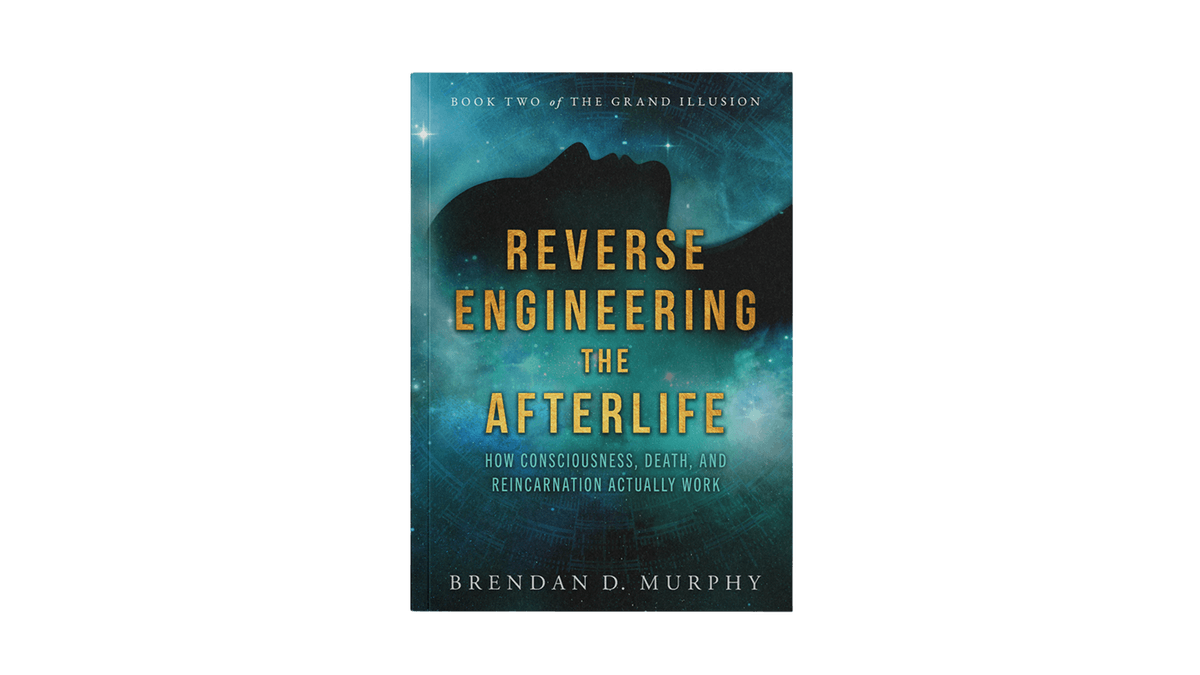
About the author
Brendan D. Murphy
Brendan D. Murphy is a consciousness researcher and author of The Grand Illusion and Reverse Engineering the Afterlife. Working at the intersection of consciousness science, comparative metaphysics, and systems thinking, he maps the architecture of consciousness and post-mortem states without the constraints of religion, materialism, or New Age ideology. He is the creator of the Consciousness Transition Model—the first structured, cross-tradition framework of how consciousness moves through post-mortem states. He publishes regularly on Substack and is based in México.
More about Brendan →