Earthbound Souls: What Happens When Consciousness Gets Stuck at the Boundary
Earthbound spirits—consciousnesses that fail to complete the post-mortem transition and remain attached to the physical domain after biological death—are documented across NDE research, clinical hypnotherapy, out-of-body exploration, and cross-tradition esoteric accounts. George Ritchie's nine-minute clinical death in 1943 produced one of the most detailed first-person observations of the earthbound state on record. The phenomenon is not folklore. It is a structurally coherent feature of post-mortem consciousness that the evidence consistently describes.

Consciousness researcher and author of The Grand Illusion and Reverse Engineering the Afterlife.
George Ritchie's NDE Documented the Full Spectrum of Post-Mortem States
George Ritchie, a psychiatrist who later practised in Virginia, was clinically dead for nine minutes at the age of twenty following complications of pneumonia. This occurred in September 1943 at Camp Barkeley, Texas, where he was a recruit in army basic training. His account—published as Return from Tomorrow (1978)—is among the most structurally comprehensive single NDE reports in the literature.¹
It began with Ritchie observing himself lying unconscious in an army sick bed—a classic autoscopic OBE. Not yet understanding what had happened to him and preoccupied with the thought of returning to medical school in Richmond so as not to fall behind, he moved through the rooms and corridors of the army base attempting to get help reaching the train station. A Sergeant walked past him without acknowledgement. He was invisible.
He found a door to the outside and rushed through it; the next moment he was travelling through the air over the mesquite bushes at extraordinary speed. He stopped in an unfamiliar town and attempted to draw the attention of a man on the sidewalk—again without success. Panic set in as the realisation dawned that he might be permanently separated from his physical body. He sped back to the army base and undertook what he described as "one of the strangest searches that can ever have taken place"—moving through more than two hundred barracks trying to locate his own body.¹
When he found it, the sheets were already drawn over his face. He was dead.
Within moments the room brightened. A luminous being manifested—one Ritchie experienced and interpreted as "the Son of God," describing it as "the most totally male being I had ever met...power itself, older than time." It emanated unconditional love and appeared to hold awareness of every aspect of his entire life.¹
What followed was remarkable in its evidential scope. The luminous being then showed Ritchie the full spectrum of post-mortem states—a guided tour of the entire architecture of what consciousness encounters after the Biological Disengagement Event. This tour is what makes Ritchie's account exceptional: not the NDE itself, but the structured overview of the terrain that followed.
Ritchie's Observations of Earthbound Consciousness Are Structurally Specific
The earthbound states Ritchie observed were not vague impressions. They were structured observations with specific phenomenological detail.
He saw men and women—recently deceased—still clinging to bars and taverns, trying to consume alcohol through the bodies of living patrons. They crowded around the living, drawn to the energy of consumption they could no longer directly access. The living were unaware of them. The earthbound consciousnesses were not malevolent—they were compelled. Their addiction had not dissolved at death because addiction is a feature of consciousness, not merely of the body. The body was gone; the craving remained.¹
He observed others wandering in profound confusion—not knowing they were dead. They moved through the physical world they had always inhabited but found themselves unable to interact with it, unable to be perceived by the living, unable to understand why nothing responded to them. These were consciousnesses whose attachment to the physical world—through unfinished business, sudden violent death, or simply the inability to accept that death had occurred—had prevented them from moving into the next phase of the transition.¹
He observed others locked in continuous replay of a single moment or pattern of behaviour—caught in loops, unable to break the repetition, apparently unaware that any alternative was available to them.
And beyond these lower states, Ritchie observed the luminous realms of those who had transitioned successfully—consciousnesses operating in full awareness, engaged in purposeful activity, radiating the love and clarity that characterised the luminous being who had accompanied him throughout.¹
This spectrum—from the most attached and confused to the most luminous and free—constitutes a map of the full range of post-mortem conditions. It is not theology. It is a structured phenomenological report from a man who was clinically dead and who later became a psychiatrist—a professional whose training disposed him toward scepticism of exactly this kind of experience.
Monroe's Focus 23 Research Independently Confirmed the Earthbound State
Robert Monroe—the former radio executive whose decades of systematic out-of-body research produced the Monroe Institute's Focus level cartography—documented the same territory from an entirely different investigative direction.
Monroe's Focus 23 designates what he described as the state occupied by recently deceased individuals who remain in the vicinity of the physical world due to confusion, attachment, or inability to accept that death has occurred.² These are consciousnesses aware enough to perceive the physical environment but not progressed enough to move into the structured post-mortem domains Monroe mapped at Focus 27 and beyond. They are neither fully in the physical world nor fully in the next. They occupy the boundary.
Monroe's description aligns precisely with what Ritchie observed: confusion, repetitive behaviour, inability to communicate with the living, and in some cases apparently genuine bewilderment about what has happened to them. Monroe arrived at this through hundreds of controlled OBE sessions, with no prior exposure to Ritchie's account. The structural convergence between a psychiatrist's NDE and an engineer's OBE cartography—produced independently, across different decades, using different methodologies—is the signal that characterises genuine mapping of a real terrain.
Monroe also observed, consistent with Ritchie, that some earthbound consciousnesses were susceptible to what he called "retrieval"—being guided, by conscious OBE explorers, from their stuck position toward more progressed states. The possibility of retrieval implies that the earthbound state is not permanent and that these consciousnesses retain the capacity for movement when the right conditions are created.²
Clinical Evidence From Spirit Release Therapy
The clinical literature provides a parallel evidential stream. William Baldwin (1939–2004), a hypnotherapist and ordained minister who developed Spirit Release Therapy (SRT), documented systematic evidence of earthbound entity attachment in clinical practice—cases in which a living individual carried the consciousness of a recently deceased person that had not completed its own transition.³
Baldwin's methodology involved placing the client in hypnotic regression and facilitating direct communication with the attached entity. The entity's account—its circumstances of death, its reason for attachment, its current confusion or distress—was then addressed therapeutically, with the aim of facilitating its movement toward the post-mortem state appropriate to it.
Across thousands of clinical sessions, Baldwin documented consistent patterns: the attached entities were frequently confused about their own death, still focused on the emotional or situational circumstances that had caused them to remain near the physical world rather than complete the transition. Violent or sudden death, unresolved relationships, addictions, fear of judgment, and strong attachment to specific living individuals were the most common anchors.³
Edith Fiore, a clinical psychologist in California, documented similar findings in The Unquiet Dead (1987)—a clinical account of entity attachment cases encountered in psychiatric practice.⁴ Her subjects presented with a range of psychological symptoms that, under hypnotic exploration, proved consistent with the presence of an attached earthbound consciousness. The therapeutic resolution of the attachment produced symptom relief in the living client alongside what appeared to be genuine movement toward completion for the attached entity.
Carl Wickland, a physician whose Thirty Years Among the Dead (1924) predates both Baldwin and Fiore by decades, documented an earlier systematic clinical approach to the same phenomenon.⁵ Wickland used his wife Anna—a sensitive—as an intermediary, facilitating communication with what he identified as earthbound consciousnesses that had attached themselves to patients presenting with psychiatric symptoms. His clinical records document hundreds of cases with consistent phenomenological features: recently deceased individuals who had not progressed, confused about their situation, occupying the perceptual boundary between the physical and non-physical domains.
Direct OBE Observation: What Jurgen Ziewe Found
Jurgen Ziewe, a German-born British artist whose decades of controlled out-of-body exploration produced the detailed phenomenological mapping published in Multidimensional Man (2008) and Vistas of Infinity (2015), documented the earthbound states from direct first-person observation.⁶
Ziewe's explorations of the lower astral domains—the post-mortem territory immediately adjacent to the physical world—consistently encountered consciousnesses in the conditions Ritchie and Monroe had described: addicts seeking substances they could no longer consume, individuals locked in repetitive behavioural loops, confused and bewildered souls unable to understand their situation. He also encountered what he described as hellish self-generated environments—consciousnesses inhabiting domains constructed from their own psychological states, sometimes horrifying in character, sometimes merely grey and isolated.⁶
What Ziewe's accounts add to the evidential picture is phenomenological texture. Unlike Ritchie's single-event NDE or Monroe's instrumented research sessions, Ziewe's explorations were sustained and repeated over decades. He returned to the same territories multiple times, observed the same categories of earthbound state under different conditions, and developed a detailed descriptive account of the full range of post-mortem conditions from direct observation—independent of any theoretical framework derived from the esoteric literature. His second volume, Vistas of Infinity (2015), extends this mapping with additional observations of the lower and middle post-mortem domains.
The Esoteric Tradition's Account: Kamaloka and Psychological Carryover
The esoteric tradition—specifically the Theosophical synthesis drawn from Hindu and Buddhist cosmology—described the earthbound state systematically long before modern NDE research, clinical hypnotherapy, or OBE cartography began documenting it independently.
In the Theosophical framework, kamaloka—the desire realm—is the post-mortem domain immediately adjacent to the physical world, populated by consciousnesses that have not moved beyond the desire nature that characterised their physical lives. It is not punishment. It is structure. Consciousness inhabiting kamaloka is there because its own psychological content holds it there—attachment, craving, confusion, fear of what lies beyond, or simple inability to accept the fact of physical death.⁷
Arthur Powell's compilation of Theosophical teaching on the astral body describes the lowest sub-plane of the astral as a domain where consciousness is most dense and most constrained—closest to physical matter in its vibrational character, occupied by those whose lives were dominated by coarse physical desires and whose post-mortem condition reflects exactly this.⁷ The higher sub-planes become progressively less constrained, more luminous, and more fully post-mortem in character—Ritchie's spectrum from the bars to the luminous realms described in exactly this graduated structure.
Charles Leadbeater's clairvoyant observations, compiled across decades and synthesised in The Astral Plane and The Inner Life, document the same architectural structure.⁸ The bewildered souls who don't know they're dead; the addicts clinging to physical gratification; the obsessives locked in repetitive behaviour—all described in detail by clairvoyant observation, independent of and predating the NDE research and clinical hypnotherapy literature that subsequently confirmed the same categories.
Beyond the Earthbound: Vampiric Entities, Wild Ones, and Elementals
The earthbound state is the most immediately relevant category for understanding consciousness stuck after death—but it exists within a broader taxonomy of non-physical entities that the esoteric literature and some researchers have documented.
Beyond the confused recently deceased, the OBE literature and esoteric tradition describe what Robert Monroe termed "wild ones"—non-human intelligences or severely fragmented human consciousnesses operating in the lower astral that behave in predatory or chaotic ways—and vampiric entities that sustain themselves on the emotional energy of the living. Paul Eno, a former Catholic priest turned parapsychology researcher, documented astral parasites of this kind in clinical and investigative contexts.⁹ The dark plasma model developed by physicist Jay Alfred—incorporated into the Consciousness Transition Model's framework—offers a different account: these entities are plasma-based life-forms that evolved within dark plasma environments, the same invisible plasma substrate that constitutes the subtle body architecture and the post-mortem domains themselves. Dark plasma is not non-physical in the conventional sense—it is physical matter that does not emit visible light and is therefore imperceptible to ordinary human senses. This convergences with the Vedantic conception of the subtle planes, which does not treat them as immaterial but as composed of progressively finer grades of prakriti—primordial substance—vibrating at rates beyond the range of gross physical perception. Both frameworks insist the subtle domains are genuinely substantial: real matter with real structure, not mind-generated abstraction. Alfred calls it dark plasma; Vedantic cosmology calls it subtle prakriti. The structural claim is the same. On Alfred's model, predatory or chaotic non-human entities are plasma organisms with neurological-like structures arising from plasma self-organisation—distinct in origin and nature from recently deceased human consciousnesses, and operating in overlapping but distinct territory. These are separate from the earthbound human consciousness that is the focus of this article, but they inhabit overlapping territory and are documented in the same investigative traditions.
What the CTM Maps Across All These Independent Accounts
The convergence across George Ritchie's nine-minute clinical death, Robert Monroe's hundreds of OBE sessions, William Baldwin's thousands of clinical SRT cases, Edith Fiore's psychiatric practice, Carl Wickland's three decades of clinical documentation, Jurgen Ziewe's sustained OBE exploration, and the Theosophical tradition's kamaloka framework is not coincidental. These are independent investigators working across different centuries, different countries, different methodologies, and different theoretical frameworks. They describe the same structural territory.
The Consciousness Transition Model maps this territory through the concept of Psychological Carryover: the psychological content—attachments, addictions, unresolved relationships, fears, beliefs about what death means—that consciousness brings into the post-mortem state and that shapes the Consciousness Operating Environment it inhabits. For most consciousnesses, Psychological Carryover is processed and integrated over time as the transition progresses. For some, it is so dominant—or so specifically anchored to the physical world—that it prevents full progression through the Biological Disengagement Event. These are the earthbound consciousnesses that Ritchie observed, that Monroe mapped at Focus 23, that Baldwin and Fiore encountered clinically, and that the esoteric tradition identified as inhabiting kamaloka.
The earthbound state is not permanent. The clinical evidence—Baldwin's SRT sessions, Wickland's documentation, Monroe's retrieval observations—consistently indicates that these consciousnesses can and do progress when the appropriate conditions are created. The anchor is Psychological Carryover. When that anchor dissolves—through the passage of time, through therapeutic intervention, through the assistance of more progressed consciousnesses, or through the consciousness's own eventual recognition of its situation—the transition can complete.
This is structurally significant for how we understand both ghost phenomena and certain classes of psychological disturbance in the living. What presents as haunting may be a recently deceased consciousness that has not yet understood its situation. What presents as certain psychiatric symptoms may, in some cases, involve the attachment of a stuck consciousness to a living individual. These are not claims that require abandoning critical thinking. They are structural inferences from a convergent evidential record that multiple independent researchers have produced across more than a century of systematic investigation.
"Ritchie's guided tour of the post-mortem spectrum—from the earthbound addicts at the bars to the luminous realms of those who had transitioned successfully—constitutes a map of the full range of post-mortem conditions. It is not theology. It is a structured phenomenological report from a man who subsequently became a psychiatrist."
Frequently Asked Questions
What are earthbound spirits and is there evidence for them?
Earthbound spirits are consciousnesses that remain attached to the physical domain after biological death, failing to complete the post-mortem transition. The evidence for them spans multiple independent research traditions: George Ritchie's 1943 NDE documented the earthbound state from direct observation during clinical death; Robert Monroe's OBE cartography identified Focus 23 as the state occupied by confused, recently deceased individuals; William Baldwin's Spirit Release Therapy documented thousands of clinical cases of earthbound entity attachment in living individuals; and the Theosophical tradition's kamaloka framework described the same structural conditions through clairvoyant observation predating modern research by decades.
What causes a soul to become earthbound?
The most consistently documented causes of consciousness getting stuck after death are: unresolved attachments to specific living individuals; addiction to substances or experiences that can no longer be directly accessed without a physical body; sudden or violent death that leaves the consciousness confused about its situation; strong fear of judgment or of what lies beyond the physical; and simple inability to accept that physical death has occurred. In the Consciousness Transition Model, these are collectively framed as Psychological Carryover—the psychological content that consciousness brings into the post-mortem state and that, when sufficiently dominant, anchors it to the physical domain rather than allowing full progression.
What did George Ritchie see during his NDE?
During his nine-minute clinical death in 1943, George Ritchie was shown the full spectrum of post-mortem states by a luminous being. Among what he observed: earthbound consciousnesses of addicts clinging to bars and taverns, attempting to consume alcohol through the bodies of living patrons who were unaware of them; bewildered souls who did not know they were dead, wandering the physical world unable to interact with it; consciousnesses locked in repetitive behavioural loops; and at the other end of the spectrum, luminous realms occupied by those who had transitioned successfully. Ritchie later became a psychiatrist, and his account—published as Return from Tomorrow (1978)—is considered one of the most structurally comprehensive single NDE reports in the literature.
What is Spirit Release Therapy and what does it show about earthbound entities?
Spirit Release Therapy (SRT), developed by William Baldwin (1939–2004), is a clinical hypnotherapy methodology designed to identify and facilitate the departure of attached earthbound consciousnesses from living individuals. In thousands of clinical sessions, Baldwin documented consistent patterns: the attached entities were typically recently deceased individuals confused about their own death, anchored to the physical world by unresolved emotional circumstances, and frequently unaware that they had died. Edith Fiore's The Unquiet Dead (1987) and Carl Wickland's Thirty Years Among the Dead (1924) provide independent clinical documentation of the same phenomenon across different decades and methodologies. The therapeutic resolution of the attachment produced symptom relief in the living client alongside what appeared to be genuine movement toward completion for the attached entity.
Are earthbound spirits the same as ghosts?
The terms overlap but are not identical. In the framework supported by NDE research, OBE cartography, and clinical documentation, a ghost in the traditional sense—a presence attached to a specific location, replaying patterns of behaviour, unable to interact fully with the living—is consistent with what the evidence describes as an earthbound consciousness: a recently deceased individual who has not completed the post-mortem transition and remains anchored to familiar physical territory by Psychological Carryover. Not all anomalous phenomena attributed to ghosts are earthbound human consciousnesses—the OBE and esoteric literature document other categories of non-physical entity—but the earthbound human consciousness is the most directly evidenced category and the one that most closely corresponds to the traditional ghost account.
How does the Consciousness Transition Model explain earthbound souls?
The Consciousness Transition Model maps the earthbound state as a consequence of Psychological Carryover preventing full progression through the Biological Disengagement Event. When the psychological content a consciousness brings into the post-mortem state is so dominated by physical attachments, addictions, or unresolved circumstances that it cannot reorient toward the next phase of the transition, it remains in the domain immediately adjacent to the physical—what the Theosophical tradition calls kamaloka and what Monroe mapped as Focus 23. The CTM does not treat this as punishment or permanent: Psychological Carryover can dissolve through time, therapeutic intervention, or the consciousness's own eventual recognition of its situation, at which point the transition can continue.
References
Show 9 references
- Ritchie, G.G. Return from Tomorrow. Chosen Books, 1978. See also: Ritchie, G.G. & Sherrill, E. My Life After Dying. Hampton Roads, 1991.
- Monroe, R.A. Far Journeys. Doubleday, 1985. See also: Monroe, R.A. Ultimate Journey. Doubleday, 1994.
- Baldwin, W. Spirit Releasement Therapy: A Technique Manual. Headline Books, 1992. See also: Baldwin, W. Healing Lost Souls: Releasing Unwanted Spirits from Your Energy Body. Hampton Roads, 2003.
- Fiore, E. The Unquiet Dead: A Psychologist Treats Spirit Possession. Doubleday, 1987.
- Wickland, C.A. Thirty Years Among the Dead. National Psychological Institute, 1924.
- Ziewe, J. Multidimensional Man. Lulu Press, 2008. See also: Ziewe, J. Vistas of Infinity: How to Enjoy Life When You Are Dead. Lulu Press, 2015.
- Powell, A.E. The Astral Body and Other Astral Phenomena. Theosophical Publishing House, 1926. See also: Leadbeater, C.W. The Astral Plane. Theosophical Publishing House, 1895.
- Leadbeater, C.W. The Inner Life. Theosophical Publishing House, 1910.
- Eno, P. Turning Home: God, Ghosts, and Human Destiny. New River Press, 2006.
Explore Further
→ The Consciousness Transition Model — The first structural map of how consciousness moves through post-mortem states.
→ Crisis Apparitions: What Deathbed Visions Prove About Consciousness at Death — Related evidential stream on consciousness at the physical boundary.
→ What Happens When We Sleep: The Nightly Out-of-Body State — How the sleep-state boundary between physical and non-physical operates.
→ Testing the Astral Projectors: What OBE Experiments Proved About Consciousness — The controlled laboratory evidence that consciousness operates outside the body.
→ Life After Death: Why Neither Science Nor Religion Has the Full Answer — The full evidential case for post-mortem consciousness across four independent research streams.
→ Reverse Engineering the Afterlife — Book 2: the full CTM account of post-mortem states including earthbound conditions.
Brendan D. Murphy
Reverse Engineering the Afterlife
The full CTM account—post-mortem mechanics, substrate independence, and the structural map of what comes next.
Pre-Order Now →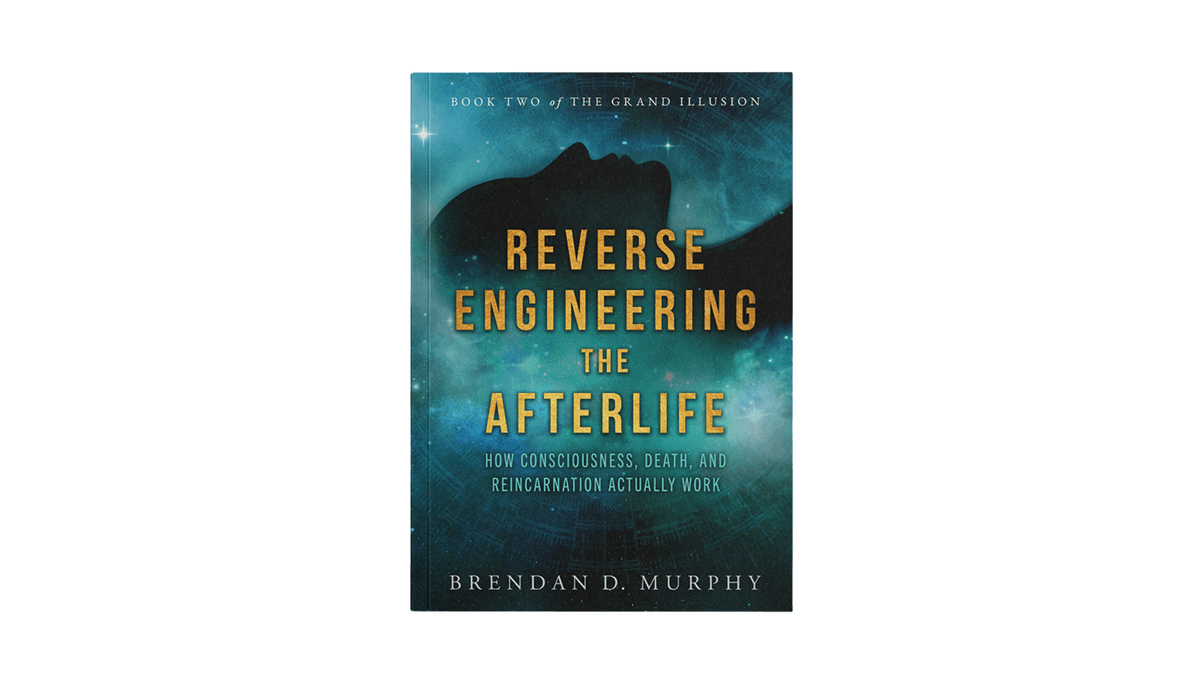
About the author
Brendan D. Murphy
Brendan D. Murphy is a consciousness researcher and author of The Grand Illusion and Reverse Engineering the Afterlife. Working at the intersection of consciousness science, comparative metaphysics, and systems thinking, he maps the architecture of consciousness and post-mortem states without the constraints of religion, materialism, or New Age ideology. He is the creator of the Consciousness Transition Model—the first structured, cross-tradition framework of how consciousness moves through post-mortem states. He publishes regularly on Substack and is based in México.
More about Brendan →